





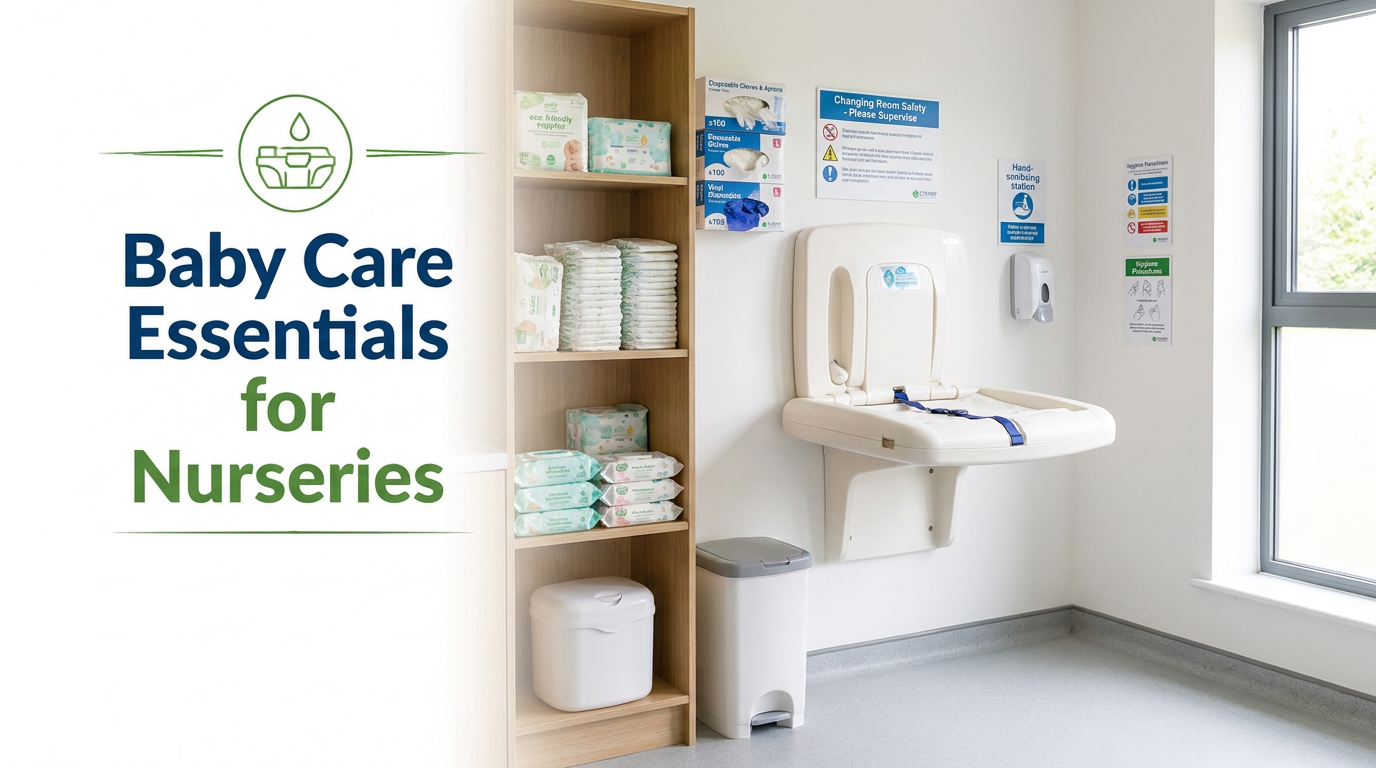
Baby care in a nursery or early years setting sits under a different set of rules to general classroom cleaning. Changing areas and feeding spaces are covered by specific requirements under the Early Years Foundation Stage framework, and inspectors pay close attention to how consistently these routines are followed, not just whether the right products are in the cupboard.
This guide covers the essentials for changing areas, nappy disposal, feeding hygiene and staff protection, along with the compliance points that most commonly trip settings up during an inspection.
Changing area hygiene and surfaces
Changing mats need a sanitiser that's effective against a broad range of bacteria and viruses, including norovirus and E. coli, applied after every single change, not periodically through the day. Most suitable sanitisers need at least one minute of contact time to work properly, which is longer than the quick wipe many staff default to when moving straight on to the next child.
Disposable paper roll or liners under each child during changing reduce the surface area that needs sanitising and cut down on cross-contamination between children using the same mat throughout the day. This is a small cost per change but a significant reduction in risk, and most Ofsted inspectors will specifically ask how a setting manages this between uses.
Changing mats themselves should be checked regularly for splits or tears in the surface. A damaged mat can't be properly sanitised because fluid and bacteria get into the underlying foam, and a cracked mat is one of the more common hygiene findings during inspection visits.
Positioning and layout
Changing areas should be physically separated from food preparation and feeding spaces wherever the building layout allows. Where space is tight and full separation isn't possible, a clear routine for handwashing and surface sanitising between using a space for changing and using it for feeding preparation becomes even more important, and staff need to understand why the sequence matters, not just follow it by rote.
Nappy disposal systems
A foot-operated, lidded nappy bin is the standard for a reason: it means staff never need to touch the bin with a soiled hand, and the lid keeps odour contained between collections. Scented liners changed at least daily, more often in a busy baby room, keep the bin from becoming the source of the smell that parents notice on arrival.
Bin placement matters as much as the bin itself. Positioning nappy disposal away from feeding and food preparation areas isn't just good practice, it's something inspectors specifically look for, and a bin that's been moved for convenience closer to a feeding area is a common finding worth checking for during a self-audit.
Collection frequency should scale with the number of children in nappies rather than following a fixed weekly schedule. A room with twelve babies in nappies will fill a standard nappy bin considerably faster than a room with three, and a collection contract that hasn't been reviewed since the room's numbers changed is worth revisiting.
Feeding area hygiene
Bottle sterilising equipment needs a clear, written routine that every member of staff follows the same way, since inconsistency here is one of the most common issues raised in inspections. Steam sterilisers and cold-water sterilising solutions both work, but whichever method a setting uses, staff need to know the correct cycle time and how long a sterilised bottle stays safe to use before it needs re-sterilising.
Feeding surfaces, high chairs, tables and any shared feeding equipment should be cleaned with a food-safe sanitiser between each child, not just at the end of a session. Allergen considerations matter here too: surfaces used for a child with a known allergy need to be cleaned thoroughly before use by another child, and settings with multiple allergies in one room often find it easier to use colour-coded or clearly labelled equipment kept separate for each child.
PPE for staff handling changing and feeding
Disposable gloves and aprons should be changed between every single nappy change, not reused across multiple children even within a short space of time. This sounds obvious written down, but it's one of the areas where time pressure during busy periods leads to shortcuts, and it's worth building the expectation into training rather than assuming it's understood.
Handwashing before and after every change and before any feeding-related task remains the single most effective control available, more effective than any product on the shelf. Stocking handwashing facilities close enough to the changing area that staff aren't tempted to skip the step, or to substitute hand sanitiser for proper washing when visibly soiled hands need soap and water, is worth checking as part of a wider layout review.
Compliance and record keeping
Cleaning chemicals used anywhere in a baby room, including sanitising sprays for changing mats, must be stored completely out of reach of children at all times, ideally in a locked cupboard rather than simply a high shelf. This is a specific and non-negotiable EYFS requirement, and it's one of the first things an inspector will check in a baby room.
COSHH data sheets for every chemical product in use should be current, easily accessible to staff, and specific to the actual products in the cupboard rather than a generic set kept from a previous supplier. When products change, the file needs updating at the same time, not at the next scheduled review.
Many settings also keep a simple daily or weekly checklist recording that changing area sanitising, nappy bin servicing and sterilising equipment maintenance have all been carried out. This isn't a statutory requirement in every case, but it creates a useful record if a concern is ever raised, and it helps new or temporary staff follow the correct routine consistently.
Staff training and consistency
New starters and bank staff need the same level of training on changing and feeding hygiene as permanent staff, delivered before they're left responsible for these tasks unsupervised. A written one-page routine for changing, disposal and sterilising, kept in the baby room itself rather than filed away in an office, gives temporary staff something concrete to follow on their first shift.
Refresher training two or three times a year, even for experienced staff, catches the small drift in routine that happens naturally over time, particularly around dwell times for sanitisers and PPE changing frequency. Settings that source their baby care and cleaning supplies from a single, consistent supplier such as Citrus Cleaning Supplies often find it easier to keep this training aligned with what's actually stocked, rather than staff being trained on one product and finding a different one in the cupboard.
Seasonal and occupancy changes
Nappy changing frequency, feeding equipment use and general baby care stock consumption all scale with the number of children in the youngest rooms, and that number often shifts through the year as new starters join outside the normal September intake. A baby room that takes on several new children in January or after Easter will burn through changing mats, liners and sanitiser noticeably faster than the autumn baseline, and a reorder schedule set once in September can quietly fall behind.
Illness and teething also drive short-term spikes in consumption that are worth planning for rather than reacting to. A stomach bug moving through a baby room can double nappy and wipe usage for a week or two, and having a small buffer of stock rather than running right to the edge of the reorder point avoids a shortfall landing at the worst possible time.
Budgeting and ordering for baby care supplies
Baby care consumables are some of the most predictable costs in a nursery's supplies budget once a genuine usage baseline is established, but that baseline needs setting from real data rather than assumption. Tracking actual usage of changing mats, liners, gloves, aprons and sanitiser against room numbers for the first full month of a new intake gives a far more accurate ordering rhythm than carrying over a figure from the previous year.
A sensible approach for fast-moving items, gloves, aprons, liners and sanitiser, is to hold roughly a two to three week buffer and trigger a reorder before that buffer is touched, rather than waiting for a box to run empty. Slower-moving items, replacement changing mats or larger equipment, can run on a longer four to six week lead time without risking a gap in provision.
It's also worth reviewing supplier consistency at the same time as budgeting. Settings that source changing, feeding and general cleaning supplies from one place, rather than mixing suppliers room by room, tend to find stock levels and staff familiarity easier to manage, since everyone is working from the same products and the same training.
FAQ
How often should nappy changing mats be sanitised? After every single nappy change, using a sanitiser effective against norovirus and E. coli with at least one minute of contact time.
Where should nappy disposal bins be positioned in a nursery? Away from feeding and food preparation areas, foot-operated where possible, and lined with a liner changed at least daily.
Do cleaning chemicals need to be locked away in a baby room? Yes. All cleaning chemicals, including changing mat sanitiser, must be stored completely out of reach of children, ideally in a locked cupboard, as a specific EYFS requirement.
Should gloves be changed between every nappy change? Yes, disposable gloves and aprons should be changed after every change, along with thorough handwashing before and after, regardless of how quickly the next change follows.