







For any school, office, care setting, hospitality site or commercial building, a well-stocked cleaning trolley does more than save time. It helps cleaning teams work consistently, reduce cross-contamination risk and keep the right tools close at hand.
At Citrus Cleaning Supplies, we often see sites focus heavily on chemicals and machines, while the everyday essentials on the trolley are overlooked. However, colour-coded cleaning cloths, sponges, scourers and dusters are some of the most important items in a professional cleaning routine. They are used across desks, door handles, washrooms, kitchens, reception areas, glass, high ledges and shared touchpoints every day.
The right setup helps teams clean faster and with more confidence. Just as importantly, it makes hygiene standards easier to follow because every cloth, sponge and duster has a clear purpose.
Why colour-coded cleaning matters
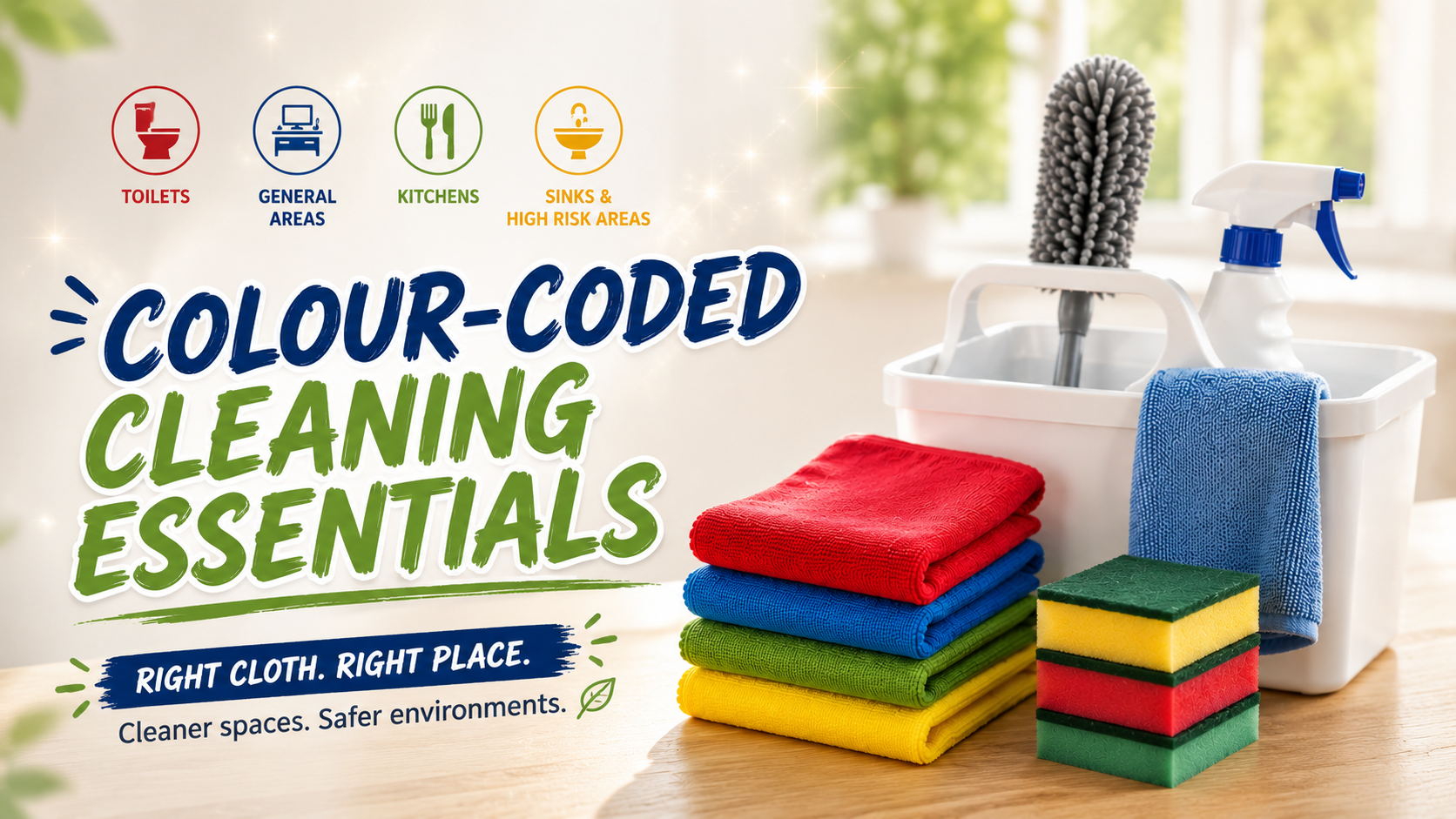
Colour coding is one of the simplest ways to reduce cross-contamination. In practice, it means assigning different coloured cleaning materials to different areas of a building. This helps stop equipment used in washrooms from being reused in classrooms, offices or kitchens.
Industry guidance commonly uses colours such as red, blue, green and yellow to separate cleaning areas. BICSc notes that these core colours are generally enough to cover the most common cleaning hazards, while NHS cleanliness standards also refer to national colour-coding schemes for cleaning materials and equipment to reduce cross-contamination risk between different areas.
For schools and offices, this is especially useful. A cleaner moving from a washroom to a staff kitchen should not have to guess which cloth to use. With a colour-coded system, the decision is already made.
A typical setup may look like this:
- Red for toilets and washrooms
- Blue for general areas such as desks, classrooms and offices
- Green for kitchens and food preparation areas
- Yellow for sinks, clinical-style areas or higher-risk cleaning tasks, depending on site policy
The exact system should match your own cleaning procedure. However, the important point is consistency. Once the colours are agreed, every cleaner should use the same system every time.
What every cleaning trolley should include
A good cleaning trolley should not be overloaded. Instead, it should carry the essentials needed for the area being cleaned.
For most schools, offices and commercial sites, we would build a trolley around:
- Colour-coded microfibre cloths
- General-purpose cloths for daily surface wiping
- Sponge scourers for tougher marks
- Dusters for shelves, ledges and high areas
- A carry tray or caddy for smaller items
- Disposable gloves or task-appropriate PPE
- Surface wipes or cleaning chemicals where needed
- Waste bags and basic spill supplies
Citrus’s housekeeping range includes microfibre cloths, scourers, dusters, gloves and cleaning accessories designed for daily professional use across hospitality, education, offices and facilities management.
Colour-coded microfibre cloths
Microfibre cloths should sit at the centre of most cleaning trolleys. They are reusable, absorbent and effective across a wide range of hard surfaces. Citrus’s microfibre range is designed for professional cleaning teams, with options across different colours, weights and textures to suit general wiping, dusting, polishing and more demanding cleaning tasks.
For schools, microfibre cloths for schools are particularly useful because they can be assigned to different zones. For example, blue cloths can be used for classroom tables, green cloths for staff kitchens and red cloths for washroom areas.
Citrus stocks a range of relevant microfibre products, including:
- QUATTRO Heavy Weight Microfibre Cloth
- QUATTRO Microfibre Super Cloth
- Robert Scott Exel Microfibre Super Cloth
- Vileda Breazy Microfibre Cloths x 25
- Vileda Micron Quick Cleaning Cloth x 5
- Vileda Professional Evolon Cloth x 10
- Vileda PVA Micro Cloths x 5
- Vileda r-MicroTuff Swift Microfibre Cloth x 5
- Wecoline Microfibre x 10
These options give procurement teams flexibility. Some sites may need a strong general-purpose cloth for everyday use, while others may prefer specialist cloths for polishing, high-frequency wiping or short-term use in areas without laundering facilities.
When to use sponges and scourers
Cloths are ideal for wiping and polishing, but they are not always the right tool for stuck-on residue. That is where sponges and scourers come in.
In kitchens, staff rooms, food tech areas and washrooms, teams often need to remove marks from sinks, tiles, worktops and other durable surfaces. However, the key is to match the scourer to the surface. A heavy-duty scourer may be suitable for some robust cleaning tasks, but it may scratch delicate finishes if used in the wrong place.
Citrus stocks practical sponge and scourer options, including Ramon Hygiene Multi-Coloured Sponge Scourers x 10, Ramon Hygiene Easy Grip Sponge Scourers x 10 and Capital Sponge Scourers x 10. The Easy Grip Sponge Scourer is described as a high-quality sponge-backed scourer with foam backing that helps protect fingers and keep the scourer flat for maximum contact. It is also listed as ideal for schools, hospitals, food factories, hotels and nursing homes.
For cleaning teams, this makes sponges and scourers useful trolley items, especially in areas where food residue, soap marks or surface build-up need more pressure than a cloth can provide.
Why dusters deserve space on the trolley
Dusters are easy to forget until a site inspection, open evening or customer visit highlights dusty ledges, vents and corners. In schools and offices, dust can build up on shelves, noticeboard tops, skirting ledges, window sills, radiators, ceiling corners and higher storage areas.
Citrus’s duster range includes tools for different dusting tasks, including extendable and telescopic dusters for hard-to-reach areas. The range is designed for homes, offices, schools and commercial buildings, with options that support safer cleaning of high ceilings, fans, ledges and cabinet tops from the ground.
One useful product example is the PULEX Cobweb and Dust Collector. Citrus describes it as a wall-mounted cleaner for cobwebs and dust, with soft, springy bristles on a durable wire frame. It is designed to push-fit onto telescopic poles and helps reach awkward corners, ledges and beams.
For schools, dusting should be part of a planned routine rather than a last-minute task. High-level dust can affect presentation, and in busy buildings it is much easier to manage when the right duster is already on the trolley.
The role of carry trays and cleaning caddies
A trolley works best when smaller items are organised. Cloths, gloves, sprays, wipes and scourers can quickly become messy if they are loose on a shelf.
This is where a carry tray or caddy helps. Citrus’s housekeeping section includes Carry Trays, and the site also highlights trolley and storage solutions as part of a well-organised housekeeping operation. It notes that commercial housekeeping trolleys help staff transport cleaning products, linen and waste materials more efficiently.
For smaller cleaning rounds, a product such as the SYR Plastic Carry Tray Blue can help teams keep essential items together. Citrus lists it as lightweight and durable, designed for organising and transporting items for everyday use.
In practice, a carry tray can be especially useful in schools where cleaners may move between classrooms, offices, staff rooms and washrooms. Instead of returning to the cupboard repeatedly, teams can carry the exact cloths, sponges and dusters they need for that zone.
How to set up a school cleaning trolley
Schools need a clear system because cleaning teams often cover very different areas in one shift. A single trolley may need to support classrooms, corridors, washrooms, offices and staff areas.
A practical school cleaning trolley could include:
For classrooms and offices
Blue microfibre cloths are a good fit for desks, tables, cupboard doors, reception counters and general touchpoints. In addition, a general duster or microfibre duster can help with shelves, skirting edges and display areas.
For kitchens and food areas
Green cloths and sponges should be reserved for kitchen-style areas, staff rooms and food preparation zones. Food areas need tighter control, so cloths and scourers should not move between kitchens and washrooms.
For washrooms
Red cloths and suitable scourers should stay in washroom areas only. If a trolley covers both washroom and non-washroom cleaning, keep red items clearly separated in a dedicated tray or compartment.
For high-level dusting
An extendable duster or cobweb tool should be available for ledges, corners and high areas. This avoids unsafe improvisation and reduces the chance of cleaners standing on furniture to reach awkward spots.
Best practice for cloth care and replacement
Reusable cloths only work well when they are cleaned and managed properly. Citrus’s microfibre guidance recommends regular washing with mild detergent and avoiding bleach and fabric softener, because softeners can coat the fibres and reduce their ability to trap dirt and moisture.
In a professional setting, we would recommend a clear routine:
- Wash reusable cloths after use
- Keep colours separate where possible
- Replace cloths when they lose absorbency or become stained
- Store clean cloths away from used cloths
- Avoid using damaged cloths on high-finish surfaces
- Keep a simple stock rotation so teams do not run short
This approach protects hygiene and helps reduce waste. It also supports cost control because good-quality microfibre can be reused many times when cared for correctly.
Common mistakes to avoid
Even good cleaning teams can lose control of trolley standards if the system is not simple enough.
The most common mistakes include:
- Mixing cloth colours between zones
- Using one sponge for too many tasks
- Leaving damp cloths inside trays overnight
- Failing to replace worn scourers
- Forgetting high-level dusting tools
- Overloading the trolley with unnecessary products
- Not training new staff on the colour code
The solution is not always buying more stock. Usually, it is about organising the stock better. A simple colour-coded system, a clean carry tray and a clear replacement routine can make everyday cleaning much more reliable.
People also ask
What are colour-coded cleaning cloths used for?
Colour-coded cleaning cloths are used to separate cleaning tasks by area. This helps reduce cross-contamination between washrooms, kitchens, classrooms, offices and general spaces.
What colour cloth should be used in school toilets?
Many sites use red for toilets and washrooms. However, every school should follow its own cleaning policy and make sure staff are trained on the chosen colour-coding system.
Are microfibre cloths better than standard cloths?
Microfibre cloths are often preferred because they trap dust, dirt and moisture effectively, leave a lint-free finish and can be reused when cleaned correctly. They are also useful across desks, glass, stainless steel, tiles and hard surfaces.
What should cleaners keep on a trolley?
A cleaning trolley should usually include colour-coded cloths, sponges, dusters, gloves, surface cleaning products, waste bags and any area-specific tools needed for the job. For larger sites, a carry tray can help keep smaller essentials organised.
Final thoughts
A professional cleaning trolley does not need to be complicated. It needs to be organised, consistent and stocked with the right essentials for the site.
For schools, offices and commercial buildings, colour-coded cleaning cloths, sponges and dusters are core tools. They support safer routines, reduce cross-contamination risk and help teams work more efficiently across different areas.
At Citrus Cleaning Supplies, we believe the best trolley setup starts with practical products that cleaners can use confidently every day. That means durable microfibre cloths, task-appropriate sponge scourers, reliable dusters, clear colour coding and simple storage solutions such as carry trays or caddies.
When these basics are right, the whole cleaning routine becomes easier to manage. Teams spend less time searching for equipment, standards stay more consistent, and every area of the building gets the right tool for the job.