







A complete guide to drain cleaning in commercial kitchens — why drains block, the right products for each situation, a daily maintenance routine, and how to stay compliant with UK food hygiene regulations.
- Why commercial kitchen drains block faster
- The risks of a blocked drain — legal and operational
- Types of drain cleaning products explained
- Drain cleaning methods — which to use and when
- Daily and weekly drain maintenance routine
- Grease traps — what they are and how to maintain them
- Choosing the right products
- Frequently asked questions
A blocked drain in a commercial kitchen is not a minor inconvenience — it is a potential enforcement action waiting to happen. Food waste, fat, oil, and grease accumulate in kitchen drainage systems far faster than in domestic settings, and the consequences of neglecting drain maintenance range from foul odours and slow drainage to visits from Environmental Health Officers and, in serious cases, forced closure.
This guide covers everything you need to know about keeping commercial kitchen drains clean, clear, and compliant — from the right daily maintenance routine to choosing the correct products from our catering and kitchen cleaning range.
Commercial kitchens produce volumes of FOGs — fats, oils, and greases — that domestic drainage systems are simply not designed to handle. Every pan of cooking oil, every roasting tray, every plate scraped into the sink contributes to a gradual build-up inside pipework that, left untreated, will eventually cause a blockage.
The process works like this: hot grease poured or washed into a drain flows freely when warm, but as it cools inside the pipe, it solidifies on the pipe walls. Food particles, soap residue, and debris then adhere to the grease layer, building it up over time into a solid blockage that no amount of hot water will shift.
- Cooking oils and fats — the primary cause of kitchen drain blockages. Even small amounts accumulate rapidly in high-volume kitchens.
- Food particles — rice, pasta, vegetable matter, and food debris cling to grease deposits and accelerate blockage formation.
- Soap and detergent residue — commercial dishwasher and sink detergents can combine with grease to form soap scum that coats pipe walls.
- Starchy waste — potato peelings, pasta water, and starchy liquid cool and swell inside pipes, contributing to blockages independently of grease.
- Scale and mineral deposits — in hard water areas, limescale accumulates inside pipes and provides a surface for grease and debris to bind to.
The Risks of a Blocked Drain — Legal and Operational
In a domestic setting, a blocked drain is an inconvenience. In a commercial kitchen operating under UK food hygiene law, it is a compliance failure with serious consequences.
- Food hygiene rating impact — blocked drains and poor drainage maintenance are directly assessed during EHO inspections under the Food Standards Agency's Food Hygiene Rating Scheme.
- Odour and cross-contamination risk — stagnant water in blocked drains generates hydrogen sulphide and other gases that create unpleasant odours and can contaminate food preparation areas.
- Pest attraction — blocked drains attract flies, cockroaches, and rodents, creating further compliance and hygiene issues.
- Operational disruption — a blocked drain during a busy service means immediate disruption, potential loss of revenue, and expensive emergency callouts.
- Grease trap overflow — a blocked or unmaintained grease trap can overflow back into the kitchen, creating an immediate food safety emergency.
Types of Drain Cleaning Products Explained
Choosing the right drain cleaning product for the right situation is critical — the wrong product used in the wrong circumstance can damage pipework, fail to address the underlying problem, or create health and safety risks in a food environment.
Drain Cleaning Methods — Which to Use and When
| Situation | Recommended Method | Product Type |
|---|---|---|
| Slow-draining sink — early stage | Biological drain maintainer applied overnight | Enzyme-based |
| Partial blockage — reduced flow | Caustic drain unblocker with 30-minute dwell | Alkaline |
| Full blockage — no drainage | Caustic unblocker + mechanical (plunger or rod) | Alkaline + mechanical |
| Grease trap maintenance | Biological treatment dosed daily or weekly | Enzyme-based |
| Limescale in pipes (hard water areas) | Acidic descaler followed by enzyme treatment | Acidic then enzyme |
| Preventative maintenance (daily) | Biological drain maintainer poured at end of service | Enzyme-based |
| Heavy FOG build-up in pipework | Professional high-pressure water jetting | Mechanical |
The most effective approach to commercial kitchen drain management is a consistent preventative routine that prevents FOG build-up from ever reaching blockage stage. This is always more cost-effective than reacting to a blocked drain mid-service.
- End of every service — scrape plates before washing. Never allow food waste, sauces, or cooking oil to be washed directly into the sink. Scrape all plates, pans, and trays into the bin before washing. This single habit reduces the volume of FOGs entering the drain system dramatically.
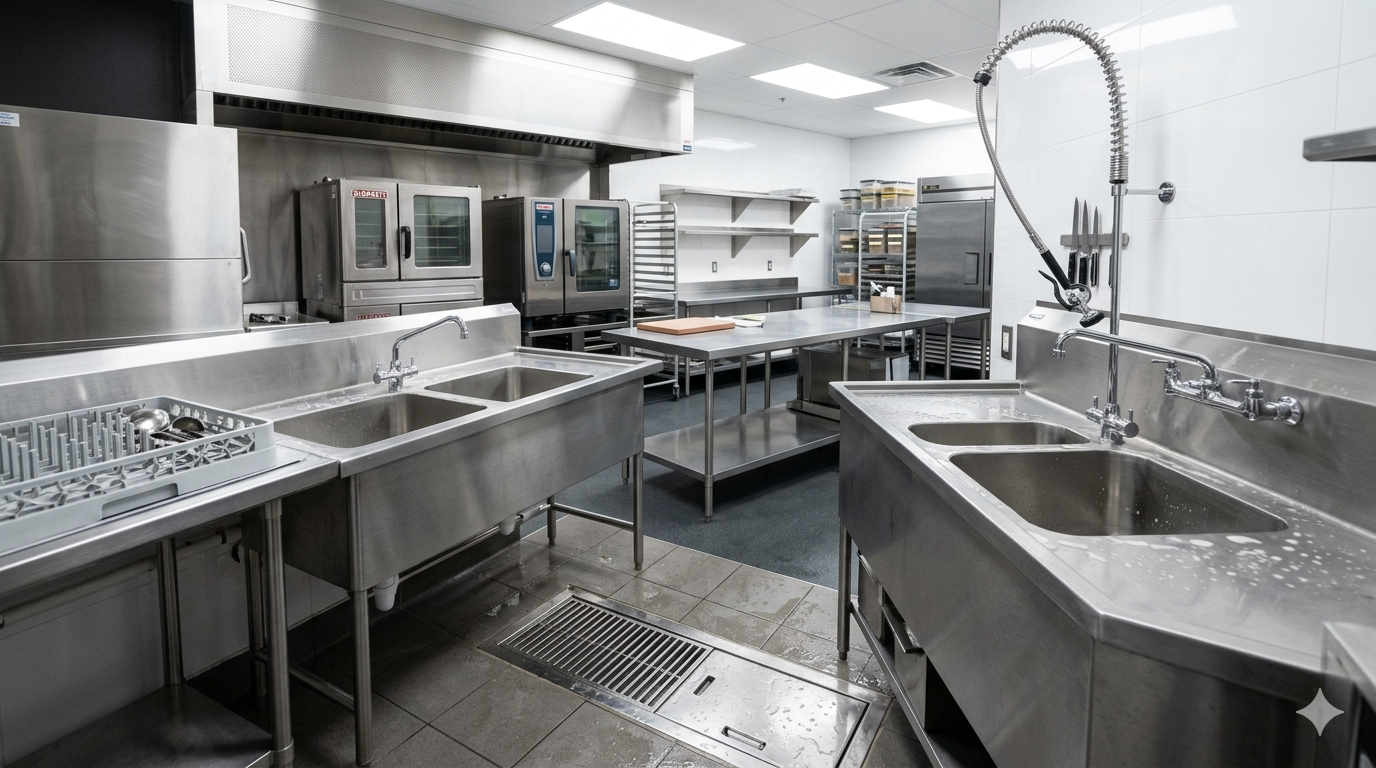
- End of every service — clean the drain cover and trap. Remove the drain cover and clean the trap underneath. Remove any accumulated food debris, fat, or solid waste by hand (wearing gloves). Rinse with hot water. A clean trap prevents the overnight accumulation of rotting food waste that produces odours.
- End of every service — apply biological drain maintainer. Pour the recommended dose of a biological enzyme drain cleaner directly into each floor drain and sink drain. Apply at the end of the day so the enzymes work overnight, digesting any grease deposits in the pipework when the drain is not in active use. This is the single most effective preventative measure available.
- Weekly — clean all floor drains thoroughly. Remove floor drain covers and clean all internal surfaces with a brush and a food-safe drain cleaner. Rinse with hot water. Check for any signs of slow drainage that might indicate early-stage build-up.
- Weekly — inspect and clean the grease trap. Check the grease trap for accumulated fat and solid waste. Clean according to the manufacturer's instructions and apply a biological treatment to maintain enzyme activity inside the trap. See the grease trap section below for full guidance.
- Monthly — review drainage performance. If any sink or floor drain is draining slower than usual, treat proactively with a caustic unblocker before a full blockage develops. Early intervention is always faster and cheaper than emergency unblocking.
Grease Traps — What They Are and How to Maintain Them
Most commercial kitchens handling significant volumes of cooking oil and fat are required to have a grease trap — a device installed in the drainage system that intercepts fats, oils, and greases before they enter the public sewer. In the UK, this requirement comes under the Water Industry Act 1991 and local authority environmental regulations.
A grease trap works by allowing wastewater to flow slowly through a baffled tank. Fat and grease float to the surface and are retained, while relatively clear water flows on to the sewer. Without regular maintenance, the grease layer accumulates until it overflows or blocks the trap entirely — at which point FOGs enter the sewer network, which can result in prosecution and significant fines from the local water authority.
- Daily biological treatment — dose the grease trap daily with a biological enzyme cleaner. The enzymes digest accumulated fat and grease within the trap and in downstream pipework, significantly extending the time between manual cleans and professional pump-outs.
- Weekly inspection — check the grease level inside the trap. As a general rule, a grease trap should be cleaned out when the grease layer reaches 25% of the trap's total capacity. Allowing it to exceed this level significantly increases the risk of overflow.
- Professional pump-out — most commercial grease traps in busy kitchens require a professional pump-out every one to three months, depending on usage volume. This should be carried out by a licensed waste contractor who will also dispose of the FOG waste in compliance with UK waste regulations.
- Record keeping — maintain a log of all grease trap inspections, cleans, and pump-outs. Environmental Health Officers may request this documentation during inspections as evidence of a compliant maintenance programme.
Choosing the Right Products
Our catering and kitchen cleaning range includes the products you need for every stage of commercial drain maintenance:
- Commercial drain unblockers (caustic/alkaline) — fast-acting formulations for clearing existing blockages. Apply directly to the drain, allow to dwell for the manufacturer's recommended time, then flush with hot water. Always use with chemical-resistant gloves and eye protection from our PPE range.
- Biological enzyme drain maintainers — the essential daily maintenance product. Safe for regular use, safe for grease traps, and safe in food environments. Pour the recommended dose into each drain at the end of the service day. Results are cumulative — the longer you use it, the better it performs.
- Grease trap treatments — specialist biological formulations designed specifically for grease trap maintenance. Higher enzyme concentration than standard drain maintainers to handle the volume of FOGs in a commercial grease trap.
- Drain cleaning tools — drain rods, brushes, and drain covers for physical maintenance of kitchen floor drains. View our full catering supplies range for available options.
- Kitchen degreasers — for cleaning the surrounding drain area, floor channels, and drain covers. A food-safe degreaser removes fat and grease from drain covers and the immediate pipework entry point. View our kitchen cleaning products.
- PPE for drain cleaning — chemical-resistant gloves, safety glasses, and protective aprons are essential when working with caustic drain cleaners. View our complete PPE and protective clothing range.
Frequently Asked Questions
Browse Our Kitchen Drain Cleaning Range
Enzyme drain maintainers, caustic unblockers, grease trap treatments, PPE, and full kitchen cleaning supplies — UK-wide delivery from Citrus Cleaning Supplies.
Browse Catering Supplies → 03300 537662