







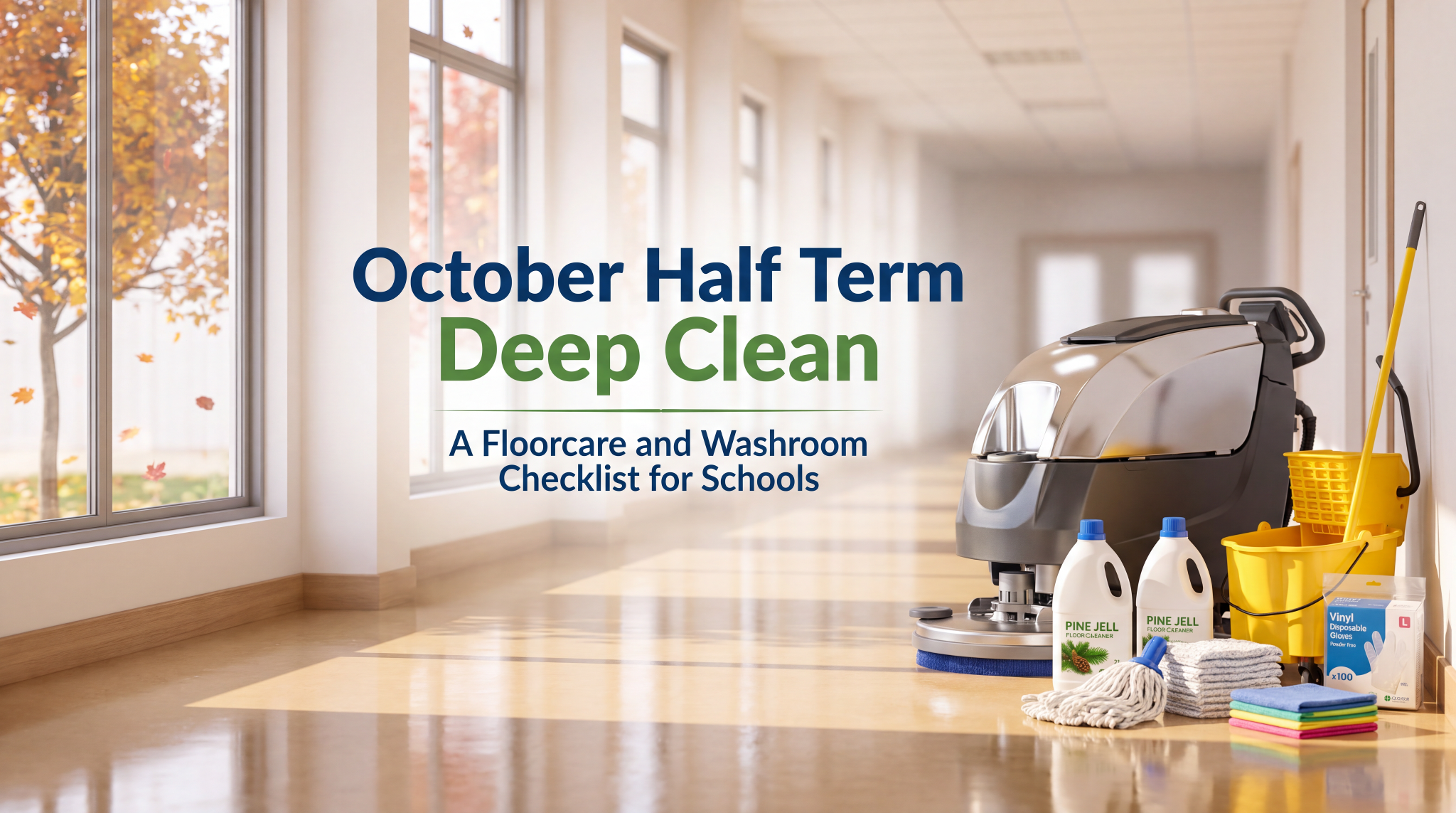
Half term gives facilities teams something a normal school week never allows: an empty building. For most of the term, floors are being walked on and washrooms are being used from early morning until after-school clubs finish, which rules out the heavier maintenance jobs that need a floor to sit untouched for hours. October half term is the first real chance since September to get ahead of that backlog, and with flu season and the Christmas term both close behind it, it is worth using properly.
This checklist works through the floorcare and washroom jobs that make the most of a half term window, along with how to plan the week so the work actually gets finished before students return.
Why half term is the right window for a deep clean
Jobs like stripping and resealing a hard floor, or running a full scrubber dryer pass across a sports hall, need drying and curing time that simply is not available during term time. Try to strip a corridor floor on a Tuesday evening and it will still be tacky for the Wednesday morning rush. Half term removes that constraint for a full week, which is long enough to sequence several jobs back to back without rushing any of them.
It also matters because of what comes straight after half term. Flu season tends to pick up through November, which means washrooms and shared touchpoints see heavier use just as half term ends. A thorough clean now, rather than a quick refresh, puts the building in a better position for that stretch rather than just looking tidy for the return.
Floorcare: what to prioritise during half term
Floor stripping and resealing is the job most worth half term's uninterrupted time. Old sealant and polish wears unevenly in corridors and entrance areas where foot traffic is heaviest, and stripping that back before reapplying polish or sealer gives a cleaner, longer-lasting finish than polishing over an already worn layer. This is also the point to check floor pads are matched to the job. Pads vary considerably by task, from aggressive stripping pads through to softer buffing and burnishing pads, and using the wrong grade either damages the floor or fails to shift what needs shifting.
Scrubber dryers earn their keep here too. A half-term pass with the right scrubber dryer chemical gets into grout lines and worn patches that daily mopping never reaches, and it is far easier to run a machine through an empty hall than to work around furniture and foot traffic during term time. While the machine is out, it is worth checking consumables at the same time, since worn brushes or pads reduce how effective even a good machine can be.
Mop heads are another area that gets neglected until they visibly fail. Traditional, hygiene and microfibre mop heads all wear at different rates depending on use, and half term is a sensible point to rotate stock, retiring anything worn or discoloured rather than waiting for it to fail mid-term. The same applies to buckets and wringers. A wringer that is not closing fully no longer gets mop heads properly damp-dry, which slows drying time and increases slip risk in corridors.
Floor signage is easy to overlook but worth checking during the same pass. Wet floor signs take knocks over a term and often go missing or get damaged, and running out during a busy corridor clean is a genuinely common problem. Restocking signage alongside the chemical and equipment check means it is ready for daily use as soon as term resumes, not just for the deep clean itself.
Washroom: refreshing stock and fittings over half term
Washrooms see some of the heaviest continuous use in a school building, and half term is the best opportunity to get into areas that daily cleaning routines do not fully reach, behind cisterns, around floor fixings, and the less visible parts of urinal and cubicle areas. A proper descale and deep clean here, rather than the daily surface wipe, resets the space before the busier winter term.
Dispensers are worth a full check during the same visit. Toilet roll, hand towel and centre feed dispensers all take knocks over a term, and a dispenser with a worn mechanism causes genuine frustration for both staff and students when it jams or fails to feed properly. Checking stainless steel and metal dispensers for damage, along with toilet roll holders like the North Shore range, catches problems while there is time to repair or replace before students are relying on them daily again.
Urinal screens and waste bins are both quick wins that make a disproportionate difference to how a washroom is perceived. A worn urinal screen stops doing its job well before it looks obviously tired, and a waste bin that is overdue for replacement or a proper clean undermines an otherwise spotless washroom. Neither takes long to address, but both are easy to miss when half term attention goes to the bigger floor and fixture jobs instead.
Toilet seat covers and consumable stock levels round out the washroom check. It is worth reviewing actual usage from the first half of term rather than ordering the same volume as last year, since class sizes and timetabling can shift consumable demand considerably from one year to the next.
Building a half-term checklist that actually gets used
A half-term deep clean works best when it is planned by day rather than treated as one long task. Splitting the week into floorcare days and washroom days, with a specific area assigned to each, makes it far easier for a facilities team to track what has actually been finished versus what still needs doing, particularly when the team includes agency or temporary cleaning cover over the holiday week.
Ordering ahead of the week, not during it, is the detail that most often gets missed. Chemicals, pads, dispenser parts and signage all need to be in stock before the Monday of half term, since a mid-week order rarely arrives in time to be useful for a job planned for that same week. Reviewing stock against the checklist a week or two before half term starts gives enough lead time to top up anything running low.
Finally, it is worth building in a short walk-through on the final day of half term, checking the building as if seeing it for the first time. This catches anything missed during the main push and means the first morning back starts from a genuinely finished job rather than a list of jobs half term ran out of time for.
Working with contract or agency cleaning cover
Many schools bring in contract or agency cleaning teams for the bigger half-term jobs, particularly floor stripping and resealing, rather than relying solely on the in-house team. This works well, but it depends on clear handover information. A contractor arriving without a sense of which areas are highest priority, or which chemicals and finishes are already in use on a given floor, risks either duplicating work already planned or using a product that does not suit the existing finish.
Sharing the half-term checklist directly with any external team before they arrive on site solves most of this. It also helps to flag any areas with known issues, a floor that has not held a seal well in the past, or a washroom with a recurring fault, so the visiting team can look at those areas specifically rather than treating the whole site as a standard job.
Recording the deep clean for future reference
A simple record of what was done during each half term, which floors were stripped and resealed, what was replaced in the washrooms, and what stock was used, is worth keeping even when there is no immediate inspection on the horizon. Over a few terms, this record builds into a genuinely useful picture of which areas need attention most often and which products and finishes are holding up well.
This is also useful evidence if a school is ever asked to demonstrate its maintenance and hygiene standards during an inspection. Rather than relying on memory, a dated record of half-term work shows a consistent pattern of proactive care rather than reactive fixes, which tends to read well regardless of who is asking to see it.
FAQ
How long should a half term deep clean actually take? This depends on the size of the site and how much is being tackled, but splitting floorcare and washroom work across different days of the week, rather than trying to do everything in one or two days, tends to produce a more thorough result.
Should floors be stripped and resealed every half term? Not necessarily every half term, but high-traffic areas like entrances and main corridors wear faster than classrooms and often benefit from stripping more regularly than the rest of the building.
What washroom items wear out fastest in schools? Dispensers and urinal screens tend to show wear before anything else, simply because of how frequently they are used and handled across a full school day.
Is one week enough time for a full floor strip across a whole school? For a large site, a full strip across every floor is often unrealistic in a single half term week. Prioritising the highest-traffic areas first, and rotating full coverage across several half terms, is usually a more realistic approach than trying to cover everything at once.