







Graffiti and gum removal in schools can become a costly maintenance problem when teams rely on general-purpose cleaners or leave marks to build up. Spray paint on brickwork, permanent markers on desks and chewing gum beneath chairs all need different products and techniques.
At Citrus Cleaning Supplies, we approach graffiti and gum removal in schools as a surface-care task, not simply a matter of using the strongest chemical available. The best results come from identifying the mark, checking the surface, selecting a specialist product and giving trained staff a clear process to follow.
Why specialist school cleaning solutions matter
Graffiti and chewing gum behave differently from ordinary dirt. Paint and ink can penetrate porous brick, stone and concrete, while gum hardens onto flooring, carpets and furniture. Standard detergents may clean the surrounding area without releasing the residue, which leads to repeated scrubbing and unnecessary surface wear.
Our Graffiti & Gum Removal range includes liquids, sprays, wipes, spot treatments, brushes and machine-based systems for paint, marker, ink and gum. These products cover school desks, walls, signs, floors, carpets and external paving. Therefore, facilities teams can match the method to the job rather than forcing one product onto every surface.
Prompt treatment also makes the site easier to manage. Fresh incidents are simpler to assess, while old gum can collect more dirt and spread across floors. Our category guidance recommends regular checks and quick removal as part of a planned maintenance routine.
Assess the mark and surface first
The first step in graffiti and gum removal in schools is to inspect the area. A product that works on brick may damage paint, plastics or coated furniture. Similarly, a heavy scraper may lift gum from concrete but scratch vinyl or laminate.
Before starting, check:
- Whether the mark is spray paint, ink, crayon, adhesive or gum
- Whether the surface is porous, sealed, painted, plastic, metal, glass, carpet or fabric
- The size and age of the deposit
- Whether the finish is already damaged
- What PPE, dwell time and rinsing method the product requires
- Whether the task should wait until pupils leave the area
Always test the selected product on a small, inconspicuous section. Our guidance recommends patch testing, following the specified dwell time and checking the result before treating the full area.
Removing graffiti from school walls and surfaces
Brick, stone and concrete
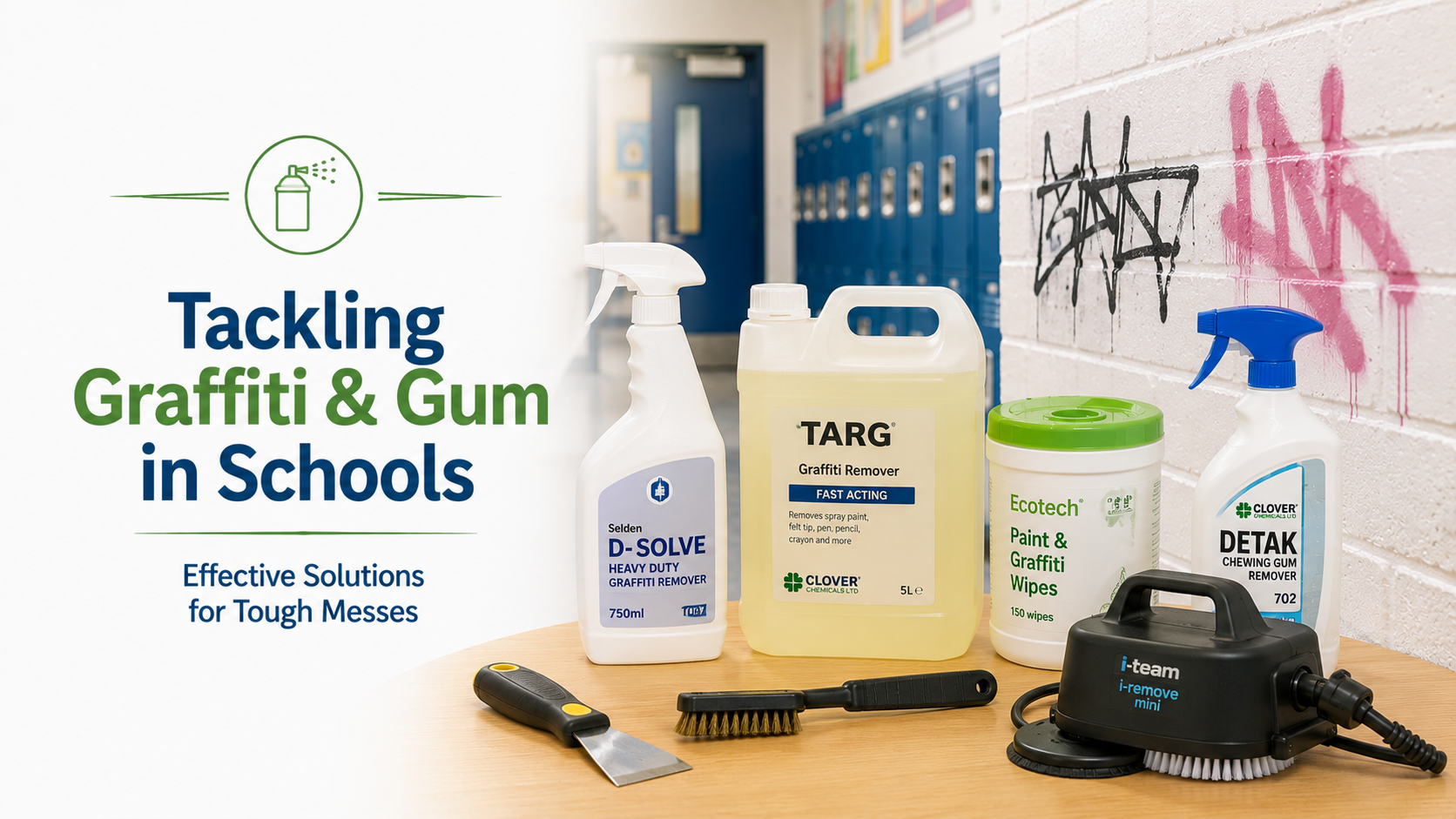
Porous external surfaces often hold paint within their texture, so removing graffiti from school walls may need a heavier-duty product. Selden D-Solve Heavy Duty Graffiti Remover 750ml is available from Citrus for compatible brick, stone and concrete.
Its instructions advise spraying the mark, allowing time to penetrate and washing it away with plenty of clean water. However, it is not suitable for plastics, paint or other solvent-sensitive surfaces.
For larger maintenance tasks, Christeyns Clover Targ Graffiti Remover 5L provides a higher-volume option. We list Targ as a fast-acting, water-rinsable and low-odour solvent product for spray paint, felt-tip pen, ballpoint pen, pencil and crayon.
Suitable materials include metal, glass, stone, wood, porcelain, brick and ceramic tiles. However, the product may dull some gloss finishes, so a patch test remains essential.
If teams use rinsing equipment or a pressure washer outdoors, they should control overspray, keep pupils away and follow the equipment instructions. HSE provides specific guidance on selecting, operating and maintaining steam and water pressure cleaners safely.
Plastics and polycarbonate
Heavy masonry cleaners are not suitable for every surface. Selden Graffiti Remover 750ml T018 is formulated for graffiti on plastics and polycarbonate, with a wash-off action designed for aerosol paint when used as directed.
This can make it relevant for some school signs, protective screens and plastic fittings. Nevertheless, staff must confirm compatibility before applying it to the full surface.
Desks, doors and small marks
For suitable flat surfaces, Ecotech Paint & Graffiti Wipes x 150 provide a portable option. We describe them as wipes for removing paint and graffiti from flat surfaces across managed premises.
In schools, they can support quick treatment of compatible desks, lockers or doors after a successful patch test. They suit isolated marks better than large wall areas and give teams more application control because the solution remains within the wipe rather than being broadly sprayed.
A practical graffiti removal process
For consistent graffiti removal in schools, use the same controlled sequence each time:
- Secure the area. Keep pupils, staff and visitors away from the treatment zone.
- Photograph and assess the mark. This records the original condition and helps identify repeat locations.
- Select a product for the exact surface. Do not assume one remover suits every material.
- Complete a patch test. Check for colour loss, dulling, softening or other changes.
- Apply the product as directed. Allow the stated dwell time instead of scrubbing immediately.
- Agitate gently where permitted. Use a compatible cloth, pad, scraper or brush.
- Rinse or wipe away residue. Follow the label and prevent run-off from spreading.
- Inspect the surface after drying. Repeat only when the product instructions allow it.
This approach is particularly important for vandalism cleaning in schools because older masonry, painted doors and coated furniture may react differently, even when the marks look similar.
Gum removal in schools
Carpets, fabrics and furniture
Gum beneath upholstered chairs or within carpet fibres needs a controlled spot treatment. Christeyns Clover Detak Chewing Gum Remover 702 is sold by Citrus for solvent-resistant carpets and fabrics.
It breaks down the structure of chewing gum so staff can remove it more easily, and its listed applications include schools, cinemas and leisure settings.
Test both the cleaner and the removal method first. Pulling hardened gum directly from carpet can stretch fibres, while aggressive scraping can damage upholstery. Instead, let the specialist treatment release the deposit, then lift it carefully with an appropriate tool.
Hard floors, paths and repeated deposits
For occasional gum on suitable hard flooring, a specialist remover and scraper may be enough. However, schools with repeated deposits across entrances, playground routes or external seating may benefit from a machine-based process.
We stock the I-Team I-Remove Mini Machine, designed to dissolve gum and stains from materials including stone, fabric and carpet. The range also includes a battery-powered I-Remove supplied with a battery and charger.
Its portable design avoids trailing cables. Meanwhile, heated chemical treatment turns gum into a non-sticky residue that can be brushed or rinsed away.
For a small school with only a few weekly spots, Christeyns Clover Detak Chewing Gum Remover combined with manual tools may offer the most practical gum removal in schools. For large campuses, multi-site trusts or contract teams, a dedicated machine can reduce repeated manual work.
Choose brushes and scrapers carefully
The removal tool should be no more aggressive than the surface requires. Citrus’s range includes soft nylon brushes, hard steel brushes and I-Remove replacement brushes. Our wider ranges also include scrapers, pads and microfibre cloths.
As a practical guide:
- Use softer tools on carpet, fabric, vinyl and finished surfaces
- Reserve steel brushes for robust, compatible exterior materials
- Keep scraper blades at a shallow angle
- Replace damaged or burred scrapers
- Avoid using the same brush for delicate and heavy-duty tasks
If staff need excessive force, stop and reassess the product, dwell time and surface. More pressure often signals that the method is unsuitable.
Safety and COSHH controls
Many graffiti removers use solvents or other active ingredients, so trained adults should carry out the work. HSE advises employers to minimise contact with harmful cleaning substances, control spills, store products safely, provide ventilation and issue suitable gloves, aprons or eye protection where the risk assessment requires them. UK school guidance also recommends appropriately trained cleaning staff with access to suitable PPE.
Keep products in their original labelled containers, retain safety data information and prevent pupil access. Staff must never mix graffiti or gum removal chemicals with other products, as incompatible chemicals can react violently, generate heat or release toxic gases.
For stronger solvent-based work, schedule treatment after school or during holiday periods wherever practical. A simple task plan should name the product, surface, PPE, ventilation, isolation period and disposal process.
What should a school keep in its removal kit?
A compact kit helps caretakers respond without searching several cupboards. Based on products and accessories available from Citrus, we would include:
- Ecotech Paint & Graffiti Wipes for suitable small marks
- A surface-specific remover such as Targ, D-Solve or Selden T018
- Clover Detak for compatible carpets and fabrics
- Microfibre cloths and non-scratch pads
- An appropriate scraper or removal brush
- Gloves and eye protection selected through the COSHH assessment
- Warning signs or barriers
- Waste bags and absorbent material
- An I-Remove machine where recurring gum volumes justify it
This keeps graffiti and gum removal in schools organised without overloading the cleaning trolley with duplicate products.
Add the task to the cleaning schedule
Reactive cleaning alone creates inconsistent results. Instead, add a graffiti and gum check to entrance, playground, corridor, dining and classroom inspections.
A practical schedule may include:
- Daily: Check entrances, corridors, toilet blocks and eating areas
- Weekly: Inspect desk undersides, chair frames, lockers and external seating
- Monthly: Review recurring locations, product use and surface damage
- School holidays: Complete larger wall, paving and carpet treatments
In addition, record repeat incidents by location and type. This helps facilities managers distinguish an isolated problem from a pattern that may need supervision, signage, surface protection or wider site action.
People also ask
What removes graffiti from school walls?
The correct product depends on the wall. D-Solve suits compatible brick, stone and concrete, while Targ covers a wider range of solvent-resistant materials. Always patch test and follow the product instructions.
How do you remove permanent markers from a school desk?
Identify the desk finish and test a suitable product first. Ecotech Paint & Graffiti Wipes may suit certain flat surfaces, while Targ is designed for several ink and pen types on compatible materials.
What is the easiest way to remove gum from carpet?
Use a specialist spot treatment such as Clover Detak on solvent-resistant carpet or fabric. Allow it to break down the gum, then lift the residue carefully instead of scraping aggressively.
Is a gum removal machine worth buying for a school?
It can be worthwhile for large campuses or sites with frequent deposits. Smaller schools with occasional gum may achieve better value with a specialist remover and manual tools.
Final thoughts
Effective graffiti and gum removal in schools depends on matching the product to the mark and surface. Heavy masonry, plastics, painted furniture, carpet and hard floors cannot all be treated in the same way.
At Citrus Cleaning Supplies, we support schools with specialist graffiti removers, portable wipes, gum treatments, machines, brushes, scrapers, cloths and PPE. The aim is not to make every response more aggressive. It is to make each response more accurate.
With fast reporting, patch testing, trained staff and suitable school cleaning solutions, teams can restore walls, desks, floors and furniture while reducing avoidable damage and replacement costs.