







Boarding schools and other residential sites run housekeeping differently to a day school. There's no evening when the building empties out and cleaning teams get the place to themselves. Bedrooms, laundry rooms, common areas and dining spaces are all in near-constant use, often across a full seven-day week, which changes what "well stocked" actually needs to mean.
This checklist works through the housekeeping stock that matters most in a residential setting, from bedding and laundry through to communal areas and guest-style amenities.
Bedding and linen care
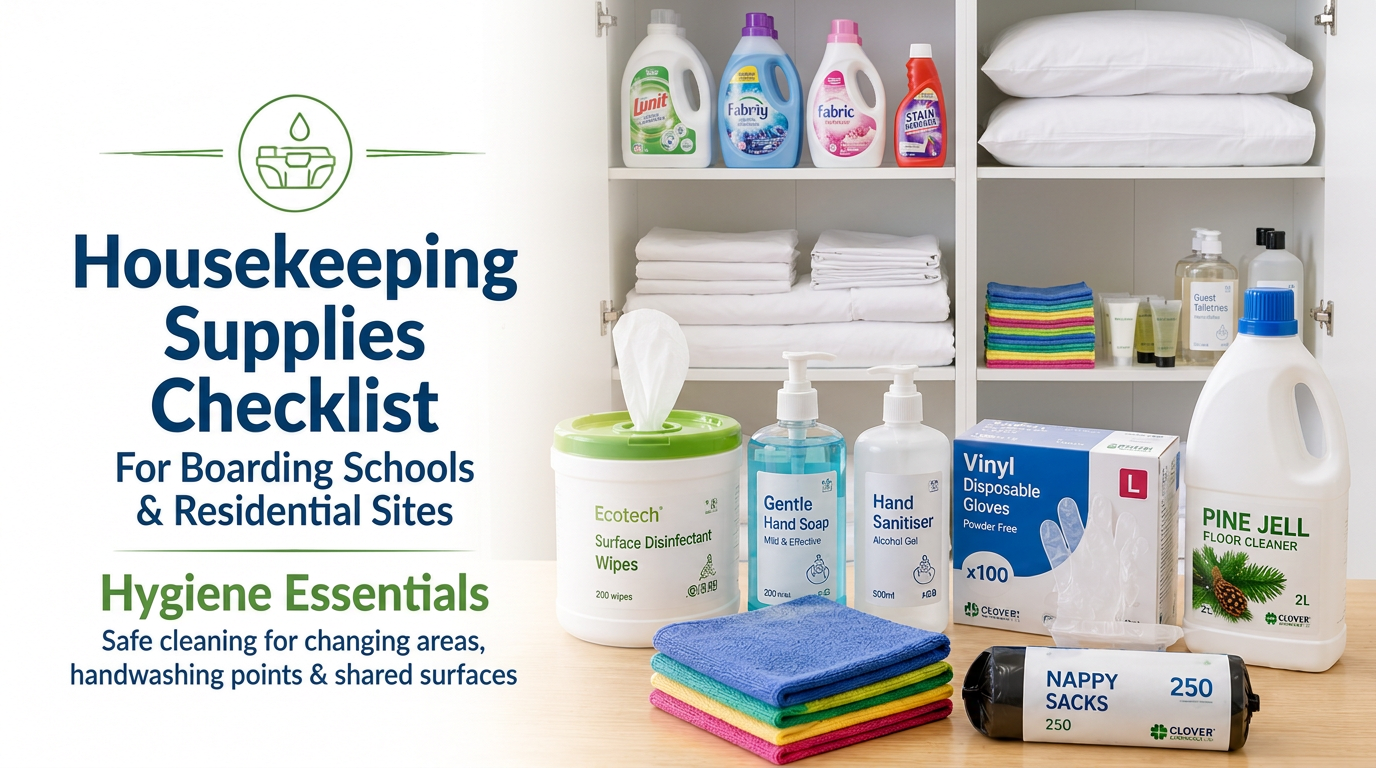
Bedding turnover is one of the biggest differences between a residential site and a standard day school. Sheets, pillowcases and duvet covers need washing on a genuine rotation, not an occasional basis, and the detergent and fabric care products used need to hold up to that volume without damaging fabric over repeated washes.
Stain removers deserve their own place on the shelf rather than being treated as an afterthought. Boarding house laundry sees a predictable range of stains, ink, food, grass and the general wear of daily use, and having a dedicated stain treatment on hand before a wash, rather than hoping a standard detergent cycle handles it, makes a real difference to how long linen actually lasts.
Fabric softener matters more in a residential setting than people often expect too. Linen that's washed daily or every few days without proper conditioning wears rougher and greys faster than linen on a lighter domestic wash cycle, and pupils and staff both notice the difference in comfort over a full term.
Stocking the laundry room properly
A boarding house laundry room needs to run like a small operation in its own right, with stock levels that match actual volume rather than a general estimate. Running short on detergent or fabric softener mid-week causes a bottleneck that's disproportionate to how small the shortage actually was, since a laundry room that stops moving backs up fast in a residential setting.
It's worth reviewing laundry stock levels against the actual number of residents and wash cycles per week, rather than ordering the same volume regardless of occupancy changes. A house that's taken on more boarders since the last order will burn through detergent, fabric softener and stain remover considerably faster, and a stock check against current numbers avoids a genuine mid-term shortage.
Guest-style amenities for boarding houses
Boarding accommodation sits somewhere between a school and a small hospitality operation, and it's worth stocking accordingly. Guest-style essentials, toiletries, and refill items for shared spaces bring a boarding house closer to the standard of care residents and parents actually expect from somewhere pupils live full time, not just visit for lessons.
Condiment and refill items for shared dining or common room spaces fall into the same category. These are easy to overlook because they're small, low-cost items individually, but running out during a busy week reads as a bigger oversight to residents than the cost of the item would suggest.
Parents visiting for exeats or open days notice these small details too, often more than they'd mention directly. A boarding house that's visibly well stocked in the shared spaces parents actually see gives a stronger impression than any amount of explaining the housekeeping standard verbally.
Keeping communal areas properly maintained
Common rooms, dining halls and shared spaces get heavier use in a residential setting than almost anywhere else on site, simply because pupils spend unstructured time there rather than passing through briefly between lessons. Furniture polish and metal polish for shared furniture and fittings, glass cleaner for windows and partitions, and surface wipes for tables and shared equipment all need restocking on a tighter cycle than a typical classroom would need.
Air fresheners and deodorisers matter more in communal residential spaces too, particularly in areas like common rooms and corridors near bedrooms, where a stale smell is noticed immediately by anyone living there full time, not just visiting for an hour.
General housekeeping stock and rotation
Cloths, microfibre cloths and dusters wear out faster in a residential site simply through volume of use, and a colour-coded system matters just as much here as it does in a school's general cleaning areas, keeping bedroom, bathroom, kitchen and communal-area cloths properly separated. Spray bottles and general cleaning chemicals should be checked regularly too, since a site running housekeeping across bedrooms, bathrooms, laundry and communal areas simultaneously goes through consumables faster than a site with a single-use pattern.
It's worth building a simple restock schedule based on actual usage rather than a fixed reorder date, since occupancy and usage in a boarding house often shifts across a term in a way a day school's usage doesn't.
Training residential staff on housekeeping standards
Residential housekeeping teams often include a mix of permanent staff, term-time cover and, in some settings, house parents who take on housekeeping duties alongside pastoral responsibilities. That mix makes consistent training more important than in a typical day-school cleaning team, since not everyone doing the work will have the same background in housekeeping standards.
A short, written reference covering laundry procedures, stock locations and what "properly stocked" looks like for each area gives new or occasional staff something concrete to follow. This matters particularly for stain treatment and fabric care, where using the wrong product on the wrong fabric can do more damage than the original stain, and a quick reference prevents costly mistakes from staff who are less familiar with the specific products in use.
Budgeting for a residential housekeeping cycle
Housekeeping consumables in a residential setting follow a different budgeting pattern to a day school, since usage is driven by occupancy and wash frequency rather than a fixed term timetable. Tracking actual detergent, fabric softener and stain remover usage against resident numbers for a full term gives a far more accurate reorder pattern than carrying over the previous year's order.
A sensible approach is to hold a two to three week buffer of fast-moving laundry and communal-area items, and reorder before that buffer is touched rather than after a shortage becomes obvious. Guest-style amenities and lower-turnover items can run on a longer four to six week lead time without risking a gap in provision. It's also worth flagging any change in resident numbers to whoever manages the order, since a new intake or an expanded boarding house can shift usage considerably from one term to the next.
Building a housekeeping checklist for residential staff
A written checklist, split by area, bedrooms, laundry, communal spaces, dining, gives residential housekeeping staff a clear reference rather than relying on memory or handover conversations between shifts. This matters especially with staff turnover or temporary cover, where a new starter won't yet have a feel for what "well stocked" looks like on that particular site.
Reviewing the checklist against actual stock levels once a term, rather than only when something runs out, catches gaps before they become a genuine shortage. Many residential sites managing this kind of stock find it easier to work from a single supplier across bedding-related laundry care, guest amenities and general housekeeping, which is one reason boarding schools often standardise their housekeeping order through a single account with Citrus Cleaning Supplies rather than piecing it together from several places.
FAQ
How often should bedding be washed in a boarding house?
This varies by site policy, but the key point operationally is having detergent, fabric softener and stain remover stock that genuinely matches the actual wash frequency, rather than being sized for occasional domestic-style use.
What's the biggest housekeeping difference between a boarding school and a day school?
Constant occupancy. Bedrooms, laundry rooms and communal areas are in near-continuous use across the week, so stock needs reviewing against real usage patterns rather than a school-term reorder cycle alone.
Should guest-style amenities really apply to a boarding house?
Many residential settings find it helps. Boarding accommodation functions closer to a small hospitality operation than a typical school building, and guest-style essentials and refill items reflect that standard of care.
How often should communal area supplies like furniture polish and glass cleaner be restocked?
More frequently than in a typical classroom, since common rooms and dining spaces see far heavier day-to-day use in a residential setting than most school areas.
Who should be responsible for housekeeping stock checks in a boarding house?
It varies by site, but assigning the check to a specific named role, rather than leaving it as a shared responsibility, tends to catch shortages earlier. A task everyone is technically responsible for often ends up belonging to no one in practice.