







Buying a cleaning trolley looks like a small decision until the wrong one arrives. A trolley too wide for a corridor, too shallow for a full colour-coded set, or built for a hotel rather than a school site ends up sitting half-used in a storeroom while staff go back to carrying supplies by hand. This guide walks through what actually matters when choosing a trolley, rather than listing every option on the shelf.
Start with the building, not the trolley
The single biggest factor in choosing the right trolley is the building it will actually be used in, not the specification sheet. Corridor widths, doorway clearances, the number of floors, and whether the site has lifts or relies on stairs all narrow the realistic options considerably before price or capacity even come into it.
Older school buildings, particularly Victorian or early twentieth-century sites, often have narrower corridors and tighter doorways than modern builds. A trolley that looks perfectly sized in a supplier's showroom can struggle to clear a doorway that was designed for a different era of building use. Walking the actual route a trolley will travel, and measuring the tightest point it needs to pass through, is worth doing before ordering rather than after.
Compact trolleys: where they earn their place
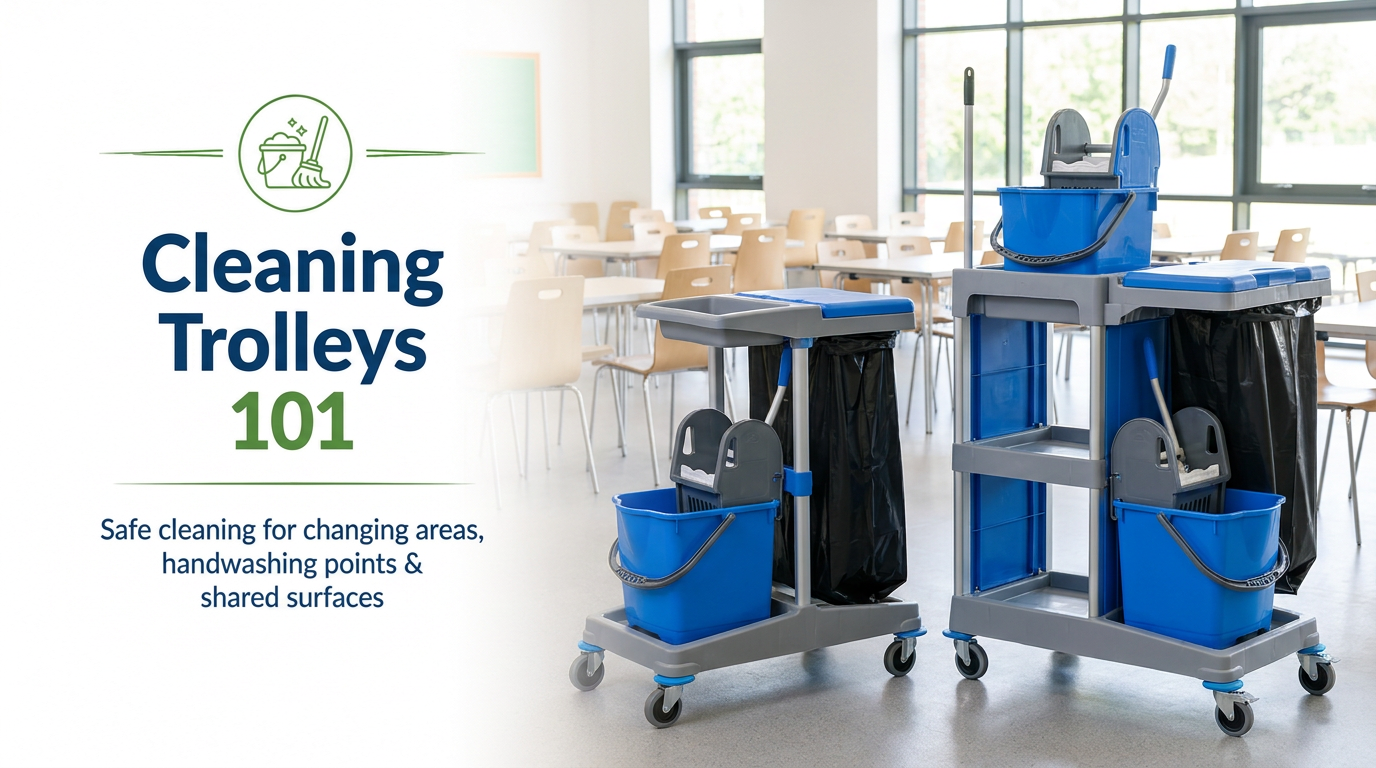
Compact trolleys, such as the smaller end of ranges like the I-Team I-LAND PRO or Numatic's Multi-Matic MM0, are built around manoeuvrability rather than maximum capacity. They suit narrow corridors, smaller sites, and staff covering a single wing or a nursery attached to a larger school, where carrying a full colour-coded range on one trolley at once isn't necessary.
The trade-off is straightforward: less capacity means more frequent trips back to the storeroom. For a focused zone or a smaller site this rarely matters, but for a cleaner covering a large, spread-out building, a compact trolley can end up costing more time in restocking trips than it saves in manoeuvrability.
Multi-shelf trolleys: where they earn their place
Multi-shelf or multi-tier trolleys, such as Numatic's Eco-Matic range running from a basic single-shelf configuration up to four and five-shelf models, or the larger I-Team I-LAND PRO L and XL sizes, are built for capacity. A well-specified multi-shelf trolley can carry a complete colour-coded set, spray bottles, cloths, refuse sacks and hand tools, all properly separated, without needing a mid-shift return to base.
This suits larger secondary schools, multi-building sites, or any setting where the storeroom is a genuine walk from the areas being cleaned. Fewer restocking trips means more actual cleaning time per shift, which matters most on sites with significant floor area to cover.
The trade-off here is size and weight. A fully loaded four or five-shelf trolley is considerably heavier and less nimble than a compact unit, and manoeuvring it through narrow stairwells or tight corners takes longer and asks more of whoever is pushing it, shift after shift.
Colour-coded trolleys and cross-contamination control
Most suppliers, Citrus Cleaning Supplies included, offer trolleys in a range of colours, typically red, blue, green and yellow, matching the standard colour-coding system used across washrooms, general areas, catering spaces and clinical or isolation zones. Choosing a trolley colour to match this system isn't just tidy, it's a visible, easy-to-audit way of showing that cross-contamination controls are actually being followed, which inspectors specifically look for.
Where budget or storage space means a single trolley can't carry every colour category, it's worth having a clear, written protocol for how the remaining colours are covered, whether that's a smaller secondary trolley, a wall-mounted store for less-used categories, or a documented rotation depending on which zone is being cleaned that day.
Laundry trolleys versus janitorial trolleys
It's worth being clear on the distinction between a janitorial trolley, built for general cleaning supplies and equipment, and a laundry trolley, built specifically for moving bedding, towels and linen. Boarding schools, nurseries and sites with PE or catering laundry needs often require both, and trying to make a single janitorial trolley do the job of a laundry trolley usually ends with soiled linen mixed with cleaning chemicals, which is exactly the kind of cross-contamination the colour-coding system exists to prevent.
Trolley accessories and spares
A trolley is only as useful as what's actually stocked on it, and it's worth budgeting for accessories, bag holders, tool caddies, mop and bucket attachments, at the same time as the trolley itself rather than as an afterthought. Ranges like I-Team's trolley accessories are designed to fit their own trolley bodies specifically, so it's worth checking compatibility before assuming a generic accessory will fit.
Spares matter just as much once a trolley is in daily use. Castors are the component that fails most often under regular wear, and keeping a small stock of replacement wheels and fixings on hand avoids a trolley being taken out of service for days while a specific part is sourced from a supplier.
Training staff on trolley protocols
A new trolley, however well specified, only works as well as the routine built around it. Staff need to know exactly which colour goes where, what to do when a compact trolley doesn't cover every category on a given round, and how to report a fault rather than continuing to use a trolley with a failing castor or a loose handle because it's still technically usable.
This matters more once a site is running a mixed fleet. A team using both compact and multi-shelf trolleys across different zones needs a clear, written note of which trolley belongs where and why, so a well-meaning member of staff doesn't move a multi-shelf trolley into a corridor it can't actually navigate simply because it happened to be free that morning. A five-minute walkthrough when a new trolley arrives, covering loading, colour-coding and basic maintenance checks, saves considerably more time than letting staff work it out through trial and error over the following weeks.
Budgeting for a trolley fleet
Trolleys are a longer-term purchase than most consumable cleaning supplies, and it's worth planning replacement and maintenance cycles rather than reacting only when a unit finally fails. A well-maintained trolley, with castors, wheels and fixings replaced as they wear rather than run to breaking point, typically lasts considerably longer than one pushed to failure, which makes a small ongoing spares budget cheaper over time than periodic full replacement.
For schools building out a fleet across multiple buildings, it's worth costing compact and multi-shelf trolleys separately against what a proper site survey actually calls for, rather than standardising on one type for simplicity. A site that needs several compact trolleys for older wings and a couple of multi-shelf units for the main block will usually spend less overall, and lose less staff time to inefficient rounds, than a site that buys identical trolleys regardless of where they'll actually be used.
Matching brand strengths to site needs
It's worth knowing that not all trolley ranges are built around the same priorities, and choosing a brand isn't purely about price. Numatic's Eco-Matic and Multi-Matic ranges are built modularly, scaling from a basic single-shelf unit up through four and five-shelf configurations, which suits sites wanting to standardise on one family and simply choose the size that fits each zone. I-Team's I-LAND PRO range sits at the more heavy-duty end, with the larger L and XL sizes built for sites running full colour-coded systems across extensive floor areas. Robert Scott is another established name worth considering where a site wants a slightly different balance of build quality and price point.
None of these is universally correct, and the right choice comes back to the same questions covered above: corridor widths, colour categories needed, and distance from storage, rather than brand name alone.
Building a shortlist before you buy
A useful way to narrow the decision is to map out, per site or per zone, three things: the tightest doorway or corridor the trolley needs to clear, how many colour-coded categories genuinely need to be carried at once, and how far the storeroom is from the areas being cleaned. Sites with narrow older buildings and a spread-out layout often end up running a mix of compact and multi-shelf trolleys rather than standardising on one type, using compact units for older wings and multi-shelf units for the main building.
Schools managing several sites, or several buildings on one site, generally find it easier to keep spares, accessories and colour-coded fittings consistent by sourcing the full range from one supplier, which is one reason facilities teams often standardise their trolley fleet through a single account with Citrus Cleaning Supplies rather than mixing suppliers building by building.
FAQ
What's the main difference between a compact and a multi-shelf cleaning trolley? A compact trolley prioritises manoeuvrability through narrow spaces but carries less stock, while a multi-shelf trolley carries a full colour-coded range but takes up more space and is heavier to move.
Do all cleaning trolleys come in colour-coded options? Most janitorial trolley ranges are available in the standard colour-coding scheme, typically red, blue, green and yellow, matching washroom, general area, catering and clinical zone colour standards.
Can one trolley cover a whole school site? It depends on the building. Sites with wide modern corridors can often run entirely on multi-shelf trolleys, while older or mixed-building sites usually need at least one compact trolley for areas a larger unit can't reach.
Are laundry trolleys and cleaning trolleys interchangeable? No. Laundry trolleys are built for linen and bedding and should be kept separate from janitorial trolleys carrying cleaning chemicals and equipment, to avoid cross-contamination between the two.