








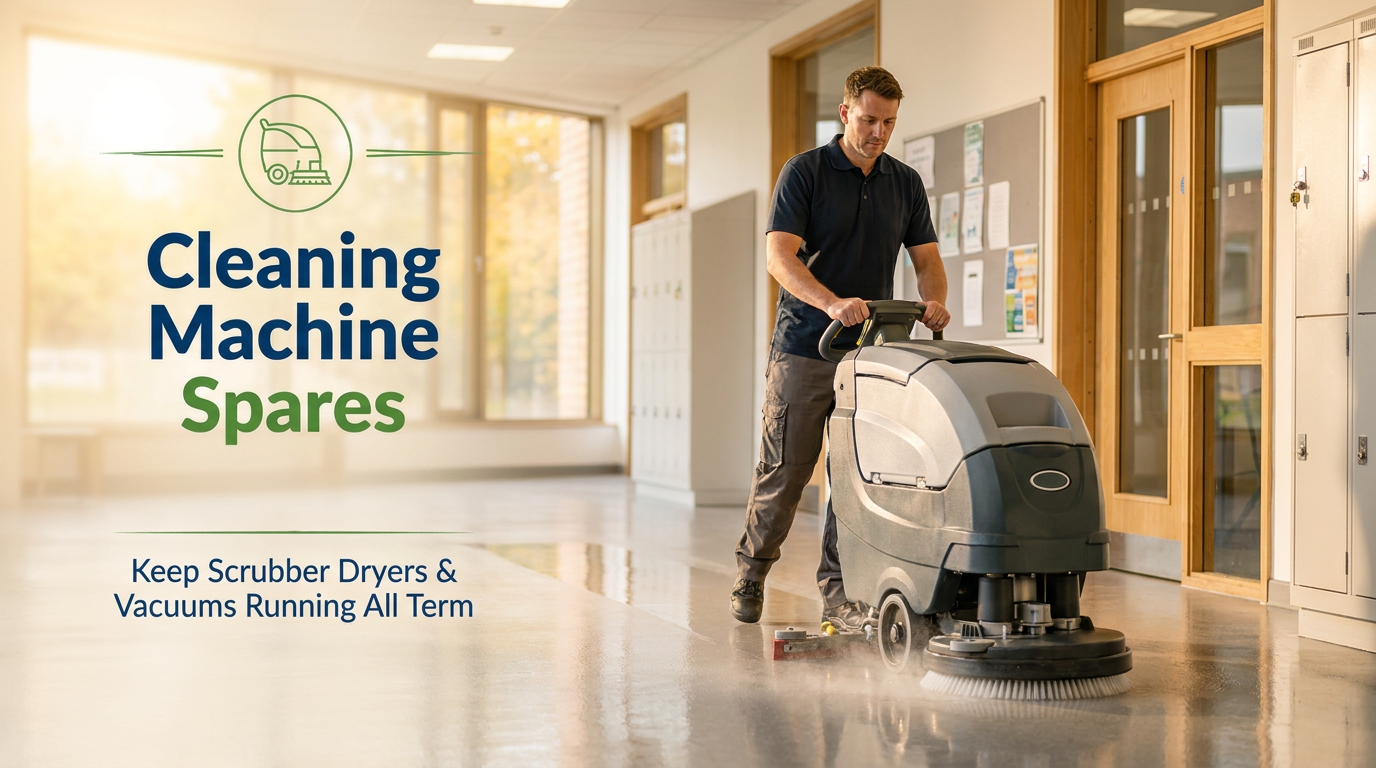
A scrubber dryer or vacuum going down mid-term rarely happens at a convenient moment. It's usually the week the machine is needed most, and the part that's failed is often one that's been quietly wearing out for weeks beforehand. Checking belts, pads, filters and batteries before term starts, rather than waiting for a machine to stop working, is the difference between a five-minute part swap and a machine sitting unused in a corridor for days.
This guide runs through the four spares worth checking now, what to look for, and roughly how often each one needs attention.
Belts
Drive belts are one of the most common failure points on floor machines, and they tend to fail gradually rather than suddenly. A belt that's starting to go usually shows signs first: a squealing noise on start-up, visible cracking or glazing along the belt surface, or a brush that spins noticeably slower than it used to even at full power.
Most facilities find it useful to check belt condition at every routine service interval rather than waiting for a fault, since a belt that looks fine at a glance can still be close to failing under load. If a belt has been in place since before the last academic year without being checked, it's worth inspecting now rather than assuming it's still good.
Pads and brushes
Floor pads and brushes wear unevenly depending on floor type and how often a machine is used, which makes them easy to under-check. A pad that's lost its texture, has visibly thinned in one area, or is leaving streaks rather than a clean finish is past the point of doing its job properly, even if it still looks roughly intact from a distance.
Brushes are worth checking for bristle length and stiffness in the same way. Bristles that have worn down significantly, or that have gone soft and floppy rather than firm, won't agitate dirt out of carpet or hard flooring the way a fresh set will, and the difference in cleaning result is often blamed on the chemical or the operator rather than the actual worn part.
Filters
A clogged or worn filter is one of the least visible spares issues, since a vacuum or scrubber dryer can keep running with a struggling filter for a surprisingly long time before anyone notices. The usual sign is reduced suction or airflow that develops gradually rather than all at once, which makes it easy to put down to "the machine's just getting old" rather than a filter that needs swapping.
It's worth building a routine filter check into the same schedule as belt and pad checks, since by the time reduced suction is obvious enough to complain about, the filter has usually been underperforming for weeks. Cartridge and standard filters both benefit from a visual check for discolouration or visible debris buildup, not just a wait-and-see approach.
Batteries
Battery-powered scrubber dryers and vacuums lose capacity gradually over their working life, and the signs are usually a shorter run time between charges and a machine that seems to lose power faster near the end of a shift than it used to. This is normal battery ageing rather than a fault, but it becomes a real problem when a machine that used to comfortably cover a full corridor round now needs recharging halfway through.
Checking battery condition before term starts, rather than discovering a machine can't finish its round in the first week, avoids staff either cutting a clean short or having to double up on charging equipment they don't have spare.
Matching spares to your machines
Spares aren't universal across machine brands, and it's worth knowing which manufacturer's parts a machine needs before a fault happens rather than during a scramble to find a replacement. Citrus Cleaning Supplies stocks machine spares across the major brands used in schools and commercial sites, including Numatic, Truvox, Prochem, Viper and I-Team, covering belts, brushes, filters, batteries and the smaller mechanical and electrical components that keep a machine running. Checking which brand and model each of your machines is before ordering saves a wasted order and a longer wait for the correct part.
Building a pre-term spares check
A simple walk-round of every scrubber dryer and vacuum on site, checking belt condition, pad and brush wear, filter cleanliness and battery performance, takes far less time than dealing with a machine going down mid-week once term is underway. Doing this in the final week or two before term starts means any parts that need ordering have time to arrive before they're actually needed.
It's worth keeping a basic record of which machines were checked and what was found, even informally, so the same machine isn't checked twice while another goes untouched. Sites running several machines across multiple buildings benefit from this kind of record most, since it's easy to assume someone else has already checked a machine that nobody actually has.
Training staff to spot wear early
The person actually using a machine day to day is usually the first to notice something's changed, often before it shows up as an obvious fault. A quieter shift, a slightly different noise, a floor that isn't coming up quite as clean, these small observations are worth capturing rather than dismissed as the operator having an off day.
A short briefing when a machine is handed over, covering what normal sounds and performance look like and who to flag a change to, means these early signs actually reach whoever's responsible for maintenance rather than being mentioned in passing and forgotten. This matters most with new or temporary staff, who won't have the same feel for how a particular machine normally runs.
Budgeting for spares across the year
Belts, pads and filters are some of the more predictable costs in a facilities budget once a genuine usage pattern is established, but that pattern needs to come from tracking actual wear rather than guessing. Machines used daily on hard flooring will go through pads considerably faster than one used occasionally on carpet, and a spares order based on machine count alone, rather than actual usage, often ends up either short or oversupplied.
A reasonable approach is to hold a small buffer stock of the fastest-wearing parts, belts, pads and filters in particular, and reorder before that buffer runs low rather than after a machine has already gone down. Batteries and less frequently replaced components can run on a longer lead time, since they're rarely needed at short notice in the same way a snapped belt is.
Common mistakes that lead to downtime
A few patterns come up repeatedly on sites that lose machine time to avoidable faults. Running a machine until a part fails completely, rather than replacing it once wear becomes visible, usually costs more in downtime than the part itself would have cost replaced early. Assuming a reduction in cleaning quality is down to technique or chemical choice, when it's actually a worn pad or a struggling filter, wastes time troubleshooting the wrong thing. And ordering spares only after a machine has already stopped, rather than keeping basic wear parts in stock, adds days of downtime waiting for delivery that a small spares stock would have avoided entirely.
Keeping a simple spares and maintenance log
A written record of what's been checked, what's been replaced and when, doesn't need to be complicated to be useful. Even a basic spreadsheet or logbook per machine, noting the date of each check and any parts swapped, makes it far easier to spot patterns, a machine that's needed three belts in a year is telling you something different to one that's needed none.
This kind of record also matters if a machine is ever queried during an inspection or an insurance claim, since being able to show a consistent maintenance history is a stronger position than relying on memory or assuming records exist somewhere. It's a small amount of admin that pays for itself the first time a machine fault needs investigating properly.
FAQ
How often should scrubber dryer belts be checked?
At every routine service interval is a reasonable minimum, with an additional visual check before a busy period like the start of term, since a belt can look fine and still be close to failing under load.
What's the main sign a filter needs replacing?
A gradual loss of suction or airflow is the most common sign, along with visible discolouration or debris buildup on inspection.
Do all machine brands use the same spares?
No. Spares are generally brand and model specific, so it's worth confirming the exact machine model before ordering a replacement part.
How do I know if reduced cleaning quality is a machine fault rather than technique?
Check the pads, brushes and filter first. A worn pad, flattened brush or clogged filter is a more common cause of poor results than operator technique, especially if the same machine used to perform noticeably better.
Is it worth keeping spare belts and filters in stock rather than ordering as needed?
Generally yes, for the fastest-wearing parts. A small on-site stock of belts, pads and filters means a worn part can be swapped the same day rather than leaving a machine out of action while a replacement is ordered and delivered.