







At Citrus Cleaning Supplies, we see this question more often from schools, site teams and larger facilities than almost any other format decision. Should you move towards refillable tablet systems such as Q-Eco Tabs, or stick with ready-to-use cleaners that are simple to grab and apply? Both approaches can work well. However, they solve different operational problems.
For busy facilities, the real issue is not which format sounds more modern. It is which format helps your team clean consistently, control waste, manage storage and keep compliance straightforward. That matters even more in schools, where cleaning teams often work around pupils, deal with limited cupboard space, and need products that are easy to train, easy to refill and easy to monitor. Citrus’s own school cleaning guidance already points towards product rationalisation, controlled dosing and smarter routines rather than simply adding more bottles to the cupboard.
What is the difference between Q-Eco Tabs and ready-to-use cleaners?
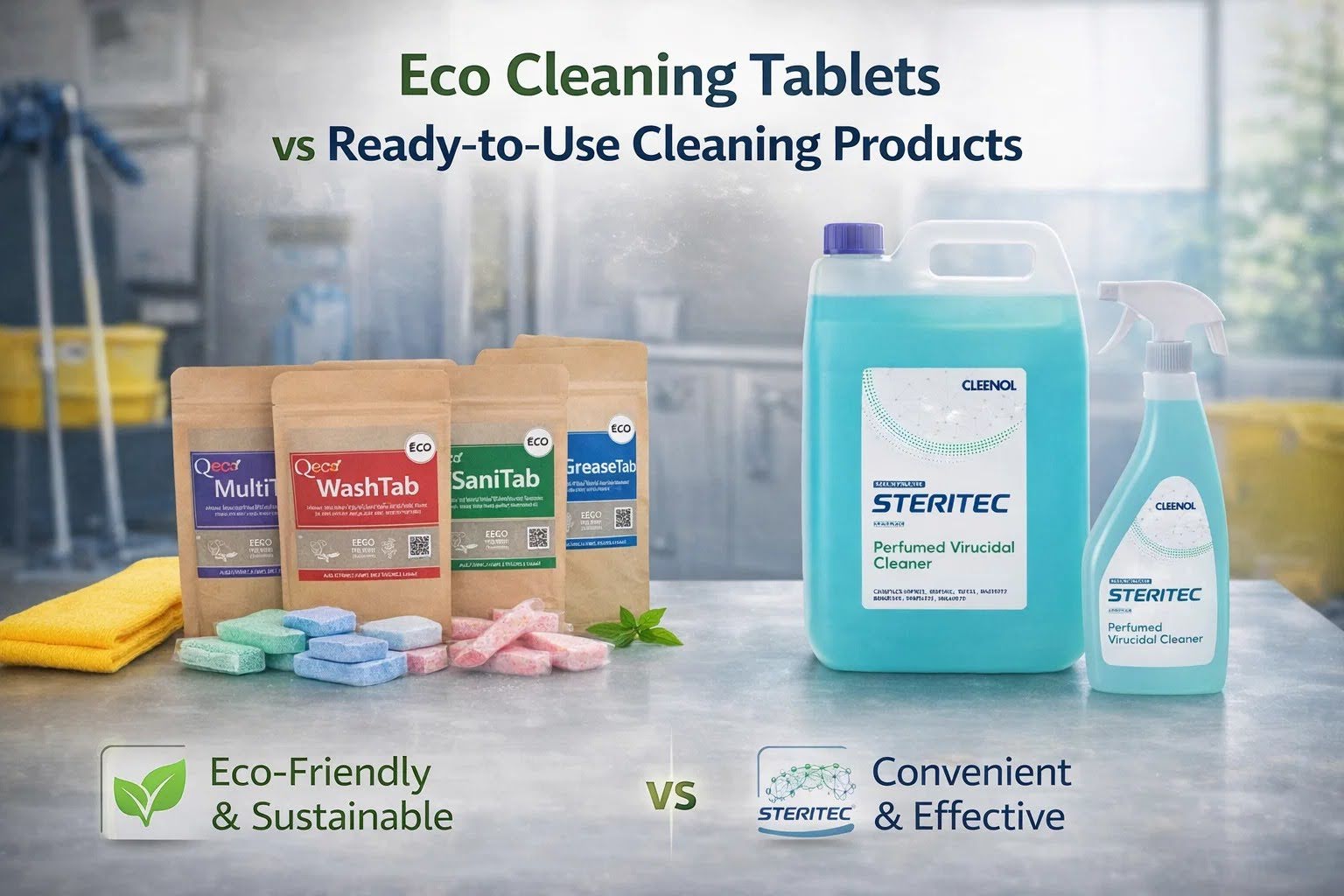
Q-Eco Tabs are concentrated tablets that dissolve in water to create a ready-to-use cleaning solution. Citrus positions them as a compact, cost-effective and environmentally conscious alternative to conventional liquid products. The range is designed to reduce plastic waste, cut storage pressure and support more consistent dilution. In practical terms, a team adds the correct tab to the correct bottle, fills with water and waits for the solution to dissolve.
Ready-to-use cleaners, by contrast, arrive pre-mixed and ready for immediate use. Citrus’s own disinfectant guidance makes the distinction clearly: concentrated formats can help facilities save on cost, while ready-to-use sprays and wipes are ideal for quick cleaning jobs. The site also stocks several relevant examples, from Clover Spray & Wipe as a daily ready-to-use surface cleaner and disinfectant, to Clover Ultra AX as a ready-to-use virucidal and bactericidal disinfectant refill.
Why format matters more than many teams think
If you manage a single classroom block, a multi-site academy trust or a large public building, product format affects more than purchasing. It changes how much stock you hold, how often staff refill bottles, how easy COSHH control feels in practice and how much packaging your site throws away. Therefore, the choice between tabs and ready-to-use products is really an operational decision, not just a chemical one.
It also helps to remember that not every task needs the same level of chemistry. UK school infection guidance says detergent and water are normally enough for most routine cleaning, while regular cleaning and disinfection should focus on surfaces in contact with food, dirt or bodily fluids, as well as frequently touched points such as handles, taps and communal touch areas. As a result, the best system is rarely “all tabs” or “all ready-to-use”. It is usually a mix built around risk and routine.
Where Q-Eco Tabs work best
1. Storage space and delivery efficiency
Q-Eco Tabs make the strongest case where cupboard space is tight and stock movement matters. Citrus describes the range as compact and lightweight, specifically because tablets remove the need for heavy liquid bottles and reduce storage and transport demands. For schools, that can make a real difference. A site team can hold more usable stock in a smaller cleaning store, and a trust buying for several sites can simplify deliveries at the same time.
That advantage grows when the same site is already managing paper products, soap refills, bin liners and seasonal stock in limited storage. In practice, swapping bulky day-to-day trigger sprays for a tablet-and-bottle system frees space for the products you cannot compress in the same way. Consequently, tabs often suit large sites with repeatable daily routines better than ad hoc, one-bottle-at-a-time purchasing.
2. Refill control and day-to-day consistency
The biggest operational strength of Q-Eco Tabs is consistency. Each tab is pre-measured, so staff do not need to guess the dilution, and Citrus states that the system is designed to eliminate overuse and provide the ideal mix each time. A pack of 10 tabs makes 10 x 750 ml trigger bottles, and Citrus also sells labelled 750 ml Q-Eco bottles that are ready to use with the correct tab, water and a trigger. That kind of standardisation is especially helpful in schools, where different cleaners may cover different areas at different times of day.
Moreover, Q-Eco Tabs give facilities a useful middle ground between large liquid concentrates and ready-to-use sprays. HSE guidance notes that overdosing increases risk and waste, and safer dilution methods are preferable to manually tipping large containers. Because the Q-Eco system is pre-measured, it reduces some of the handling and dosing problems that come with traditional concentrates, while still delivering refill and storage benefits.
3. Waste reduction and sustainability goals
For sites trying to reduce packaging waste, Q-Eco Tabs are the clearer win. Citrus states that the range is biodegradable and phosphate-free, and that using refillable bottles cuts single-use plastic compared with buying new trigger sprays each time. Its school sustainability content makes the same broader point: waste falls when teams rationalise products, control dosing and use refill systems instead of relying on constant bottle replacement.
That matters for schools in particular, because sustainability goals increasingly sit alongside hygiene and budget pressures. A tablet system will not solve waste on its own. However, when it sits inside a wider routine, with labelled bottles, clear cupboard signage and short practical training, it can make a noticeable difference to plastic use and purchasing consistency.
Where ready-to-use cleaners still make more sense
1. Speed, simplicity and quick-response cleaning
Ready-to-use cleaners still earn their place because they remove preparation altogether. If a member of staff needs to deal with a touchpoint, a welfare room surface, a reception desk or a sudden contamination issue, an RTU spray is simply faster. Citrus’s own disinfectant guidance says ready-to-use sprays and wipes are perfect for quick cleaning jobs, and that reflects how many facilities actually work. Not every task happens near a filling point, and not every operative wants to refill a bottle mid-shift.
They also suit teams with limited training time or very low daily usage. If a facility only sanitises certain areas occasionally, an RTU bottle may be more practical than introducing a refill routine that staff barely use. Similarly, for shared admin areas, transport points or caretaker response kits, ready-to-use products often win on speed and clarity.
2. Specialist disinfection and food-related areas
Some areas also justify a more specific ready-to-use product. UK school guidance is clear that food-contact areas, bodily fluid contamination and outbreak cleaning require closer control. Citrus’s product range reflects that. For example, Ultra AX is positioned as a ready-to-use virucidal and bactericidal disinfectant for washable surfaces and food preparation areas, while Evans EST-EEM is offered in both 5 litre concentrate and RTU spray bottle formats for food preparation and catering environments.
Therefore, ready-to-use cleaners still make sense when the task is specialist, urgent or tightly defined. They are also a sensible choice when you want a compliant product available immediately without any refill step. In practice, many schools keep RTU virucidal or food-safe sprays as part of a targeted response kit, even if their main daily cleaner moves to a refillable format.
Q-Eco Tabs vs ready-to-use cleaners, a practical comparison
If you want the short answer, here it is:
- Choose Q-Eco Tabs when you need to save storage space, reduce plastic waste, standardise routine cleaning and support higher-volume daily use.
- Choose ready-to-use cleaners when you need instant deployment, low-complexity application, specialist disinfection or fast response in smaller volumes.
- Choose both when your site has mixed needs, which is the reality for most schools and larger facilities.
A simple way to think about it is this. Tabs are stronger on system efficiency. Ready-to-use products are stronger on immediate convenience. As a result, the best choice depends less on chemistry and more on the rhythm of the building you are cleaning.
Which option is better for schools?
For most schools, the best answer is a hybrid model. Daily classroom and corridor cleaning often suits a refillable system such as Q-Eco Tabs, especially where the team wants to reduce bottle waste and standardise usage. The Q-Eco range itself is broad enough to support that approach, including SaniTab, WashTab, GreaseTab, GlassTab and MultiTab, so facilities can map the tablet type to the job rather than using one catch-all product everywhere.
However, schools should still keep selected ready-to-use products for quicker or more specialist work. Food areas, welfare rooms, touchpoint response kits and outbreak-related cleaning are all sensible examples. UK guidance also expects cleaning schedules to specify what is cleaned, how often and by whom, with trained staff, PPE and colour-coded equipment where appropriate. Therefore, the most effective school cleaning system is usually the one that makes everyday cleaning easy while keeping the right RTU options ready for exceptions.
For larger orders and multi-site estates, that logic becomes even more useful. Tabs help reduce storage pressure and delivery bulk across multiple buildings. Meanwhile, a smaller RTU range can be reserved for defined incident or specialist use. That gives business managers and site leads better visibility over what each site consumes, without forcing every task into the same format.
People also ask
Are Q-Eco Tabs cheaper than ready-to-use cleaners?
They often are on cost-in-use for routine cleaning, because you are paying for a concentrated tablet rather than a bottle full of water. Citrus positions Q-Eco Tabs as cost-effective, and the range is built around precise dilution, which helps reduce overuse. However, the real saving depends on whether staff refill correctly and whether the site uses enough volume to benefit from the system.
Do Q-Eco Tabs reduce plastic waste?
Yes, they can. Citrus states that the system reduces packaging and works through refillable bottles, which means less single-use plastic than repeatedly buying fresh trigger sprays. That said, waste reduction only really happens when facilities standardise bottles, maintain refill routines and avoid unnecessary duplication across cupboards.
Should every facility replace ready-to-use cleaners completely?
No. Ready-to-use products still make sense for quick cleaning jobs, specialist disinfection and areas where speed matters more than refill efficiency. In other words, tabs are not a universal replacement. They are a strong solution for routine, repeated cleaning, while RTU products remain valuable for targeted tasks.
Final verdict
So, which is better for busy facilities? If your main priority is storage efficiency, reduced packaging, refill control and sustainable day-to-day cleaning, Q-Eco Tabs are usually the smarter choice. They are especially relevant for schools and large facilities that want repeatable systems, clearer cupboard control and less plastic waste. Citrus’s Green Range positions them exactly that way, and the tablet format fits the wider move towards refill systems and controlled dosing.
If your main priority is speed, simplicity and instant deployment, ready-to-use cleaners still have an important role. Ultimately, the strongest setup is not about picking a winner in absolute terms. It is about building the right mix for the building, the team and the risk profile. At Citrus Cleaning Supplies, that is usually where the most resilient cleaning systems start, with fewer unnecessary products, clearer routines and a format choice that suits the real demands of the site.