








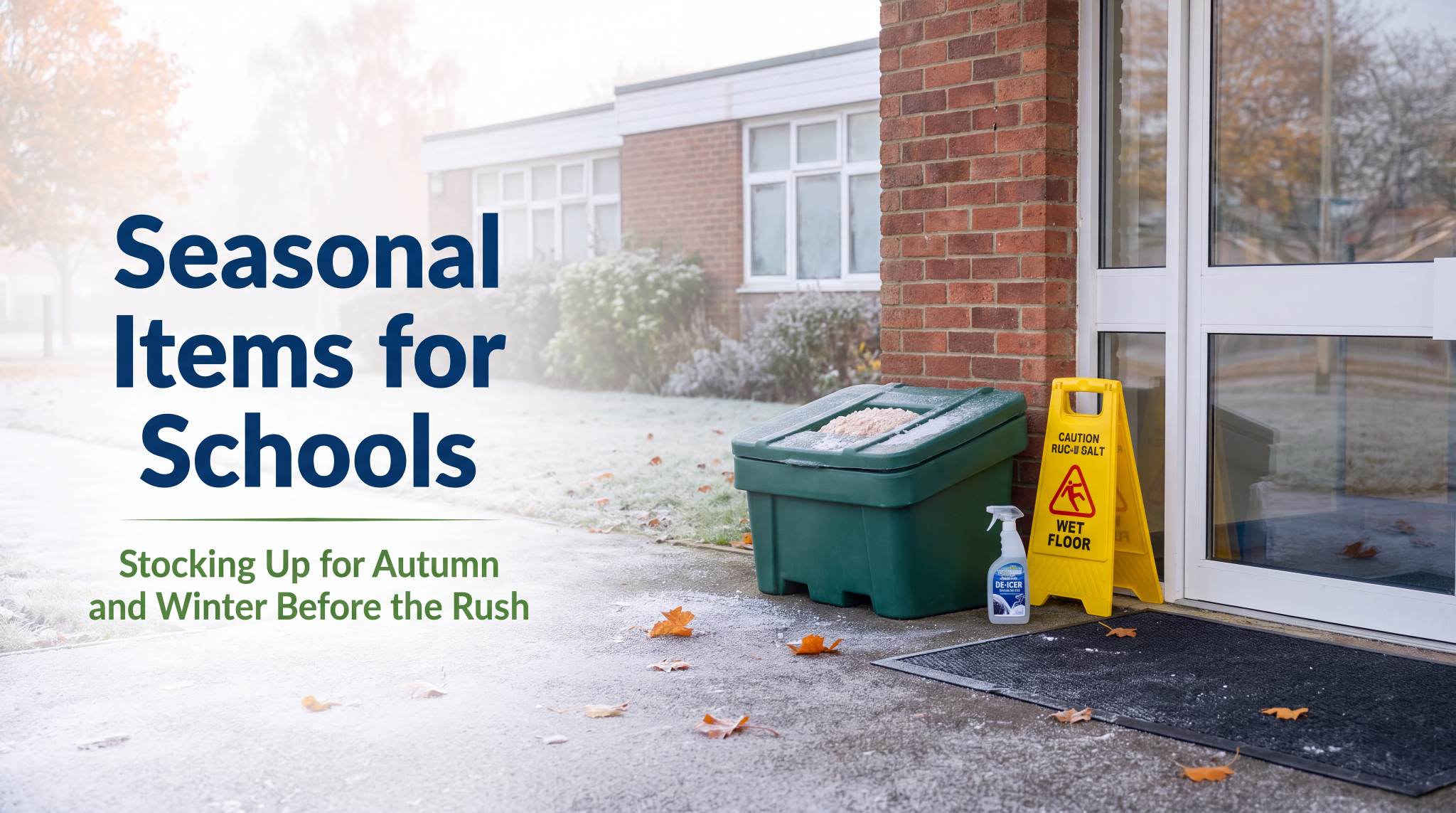
Autumn and winter bring a predictable set of demands that catch some schools out every single year. Wet weather, early darkness and the first proper cold snap all arrive within weeks of each other, and the schools that order seasonal stock in October are the ones that stay ahead of it rather than scrambling once the first icy morning hits and everyone else is placing the same order at once.
This guide covers what to prioritise when stocking up for autumn and winter, and why ordering now rather than waiting matters more than it might seem.
Why October is the right time to order
Seasonal demand is, by definition, predictable but short-lived. Once the first cold snap hits, every school, nursery and care setting in the area tends to order the same items within the same few days, which puts pressure on supply and delivery times exactly when a site needs stock fastest. Ordering in October, while demand is still manageable, avoids competing with everyone else for the same limited stock in the first properly cold week of the year.
There is also a practical site-management reason to get ahead of it. A site without de-icer or salt ready to go on the first frosty morning is reacting rather than managing, and that first icy patch on a path or car park entrance is exactly the kind of avoidable incident a stocked site should never have to deal with.
Winter essentials: salt, grit and de-icer
Salt bins and de-icer sit at the centre of any winter stock plan, and getting the quantity right matters more than people often assume. A single small salt bin by a main entrance is rarely enough for a full site, particularly schools with multiple entrances, car parks and pedestrian routes that all need treating separately during a cold snap. Mapping out every area that needs winter treatment before placing an order, rather than ordering a standard quantity and hoping it covers the site, avoids running out exactly when conditions are at their worst.
De-icer works alongside salt rather than replacing it, and having both available gives a site more flexibility depending on the specific area and surface being treated. Entrances and high-traffic walkways benefit from a fast-acting de-icer application, while salt bins positioned at key points allow for ongoing treatment throughout a cold spell without needing a fresh application every time.
Positioning matters as much as stock levels. Salt bins placed too far from the areas that actually need treating get used inconsistently, since staff are less likely to make a special trip for salt than to use what is close at hand. Reviewing bin positions each autumn, rather than leaving them wherever they ended up the previous year, is worth the small amount of time it takes.
Wet weather and indoor floor safety
Wet weather brings its own seasonal demand, particularly around entrances where outdoor wet meets indoor flooring. Floor signs warning of wet surfaces become far more important through autumn and winter than during a dry summer term, and having enough signage to cover every entrance, rather than one sign shared between several doors, reduces slip risk at the points where it matters most.
Entrance matting also earns its place on a seasonal order. A good entrance mat captures a meaningful amount of the moisture and grit that would otherwise be tracked through a building, which reduces both slip risk and the amount of extra floor cleaning needed through the wetter months. Checking existing matting for wear before the weather turns, rather than waiting until it visibly fails, keeps this protection in place when it is needed most.
Planning stock levels around actual site use
Ordering seasonal items in the same quantity every year, regardless of how the previous winter actually went, misses an opportunity to plan more accurately. A site that ran short on salt or de-icer last winter should be ordering more this year, not repeating the same order and hoping for a milder season. Reviewing what actually ran low last year, rather than relying on a standard reorder quantity, gives a far more accurate picture of what a site genuinely needs.
It is also worth building in a buffer rather than ordering to the exact quantity used last winter. Weather varies considerably from one year to the next, and a site that orders precisely to last year's usage has no margin if this winter turns out to be colder or wetter than the last one.
Building an autumn and winter seasonal checklist
A written checklist covering salt and de-icer quantities, floor signage numbers, and matting condition gives facilities teams a clear reference to work from rather than relying on memory of what was ordered the previous year. This matters particularly where responsibility for ordering shifts between staff members from one year to the next, since a new starter will not have the same sense of what the site typically needs.
Reviewing the checklist in good time, ideally by mid-October, leaves enough lead time to place an order and receive it before the first genuinely cold week arrives. Leaving this review until the weather has already turned risks placing an order at exactly the point when demand across the sector is highest and delivery times are least reliable.
Storing seasonal stock correctly
Salt, in particular, needs the right storage to stay effective through the season. Left exposed to damp, salt can clump and become difficult to spread evenly, which reduces how well it works exactly when a site needs reliable coverage. A proper salt bin or covered storage area, rather than open bags in a store cupboard, keeps stock usable throughout the colder months rather than degrading partway through winter.
De-icer and other seasonal chemicals are worth storing somewhere accessible to whoever is responsible for early-morning site checks, rather than in a general store that requires a separate trip to reach. A site where de-icer is kept right next to where it is needed gets treated faster on a frosty morning than one where staff have to retrieve it from elsewhere first.
Other seasonal considerations worth planning for
Beyond salt, de-icer, signage and matting, autumn and winter bring a handful of smaller seasonal needs that are easy to overlook until they come up. Reduced daylight hours mean entrances and car parks benefit from a check that external lighting and any illuminated signage are working properly before the clocks change, since a well-lit entrance supports safe arrival and departure just as much as a gritted path does.
It is also worth reviewing general site consumables that see increased demand through the wetter months, extra cloths and mop heads for managing tracked-in mud and moisture, and additional waste capacity for the mess that an autumn and winter term inevitably brings. None of these are large individual items, but together they make the difference between a site that feels properly prepared and one that is constantly playing catch-up through the darker months.
Reviewing supplier lead times before ordering
Lead times on seasonal items are not fixed throughout the year. They tend to be shortest in early autumn, while demand is still spread out, and lengthen considerably once the first proper cold spell arrives and every site in the area is ordering at once. Checking expected delivery times when placing an October order, rather than assuming the usual lead time will apply, helps confirm stock will actually arrive with enough margin before it is needed.
This is particularly worth factoring in for any site ordering larger quantities of salt or a specific de-icer product for the first time. A new order of an unfamiliar size or product sometimes takes longer to fulfil than a routine reorder of something already stocked regularly, so placing it with extra lead time removes the risk of a delay catching a site out.
FAQ
When should schools start ordering winter stock like salt and de-icer? October is a sensible starting point, well before the first cold snap pushes demand up across the whole sector and delivery times slow down as a result.
How much salt or de-icer does a typical school site need? This varies considerably by site size and number of entrances, but mapping every area that needs winter treatment before ordering gives a far more accurate figure than estimating a standard quantity.
Is entrance matting really necessary if floor signs are already in place? Both play a different role. Floor signs warn of a wet surface, while matting actively reduces how much moisture and grit gets tracked into the building in the first place, so the two work best together rather than as alternatives.
Should seasonal stock quantities be the same every year? Not necessarily. Reviewing what ran low the previous winter, and building in a reasonable buffer, gives a more accurate order than repeating the same quantity regardless of how the previous season actually went.