





The first frosty morning brings the first white footprints. Grit and rock salt go down on paths and car parks, and every pair of shoes carries some of it indoors. Within days, entrance floors are streaked with pale tide marks. Carpets near the door turn stiff and grey. Salt stains look minor at first, but they are far harder to deal with once they dry and build up.
This guide explains why salt damages floors and carpets, and how to remove it before it sets. It also covers the supplies that make the job quicker and the routines that keep salt out of your building. It is written for caretakers, facilities managers and school business managers who look after busy entrances.
Why salt stains are such a problem
Rock salt melts ice by dissolving into moisture. When someone walks through it, they pick up salty water and grit on their soles. That water dries on your floor and leaves the salt behind as a white, chalky residue.
On hard floors, the residue forms tide marks and dull patches. It can also leave a slightly gritty, tacky film that holds dirt and makes the floor look dirty again within hours. On carpet, it works its way into the pile and the backing. Salt attracts moisture, so a carpet with salt in it can stay damp for longer. Over time, the fibres go stiff and the colour looks flat.
Grit makes things worse. The small stones that travel in with the salt scratch floor finishes and wear down carpet fibres. A floor that looks fine in October can look tired by January if the salt and grit are left to build up.
There is a safety angle too. A damp entrance with salty water and grit is slippery underfoot. Staff and pupils need a dry, clean floor, and that starts at the door.
Act early: salt is easiest to remove when it is fresh
Salt dissolves in water. That sounds like good news, and it is, but only if you deal with it before it dries and soaks deep into the surface. Fresh salt and slush are easy to lift. Dried and compacted salt takes more effort, more product and more time.
The simple rule is to clear salt little and often. A quick daily routine at each entrance beats a long deep clean once a month. Build that routine into your cleaning schedule from the first cold week.
Remove salt from hard floors
Follow the same order each time. It stops you spreading the salt around.
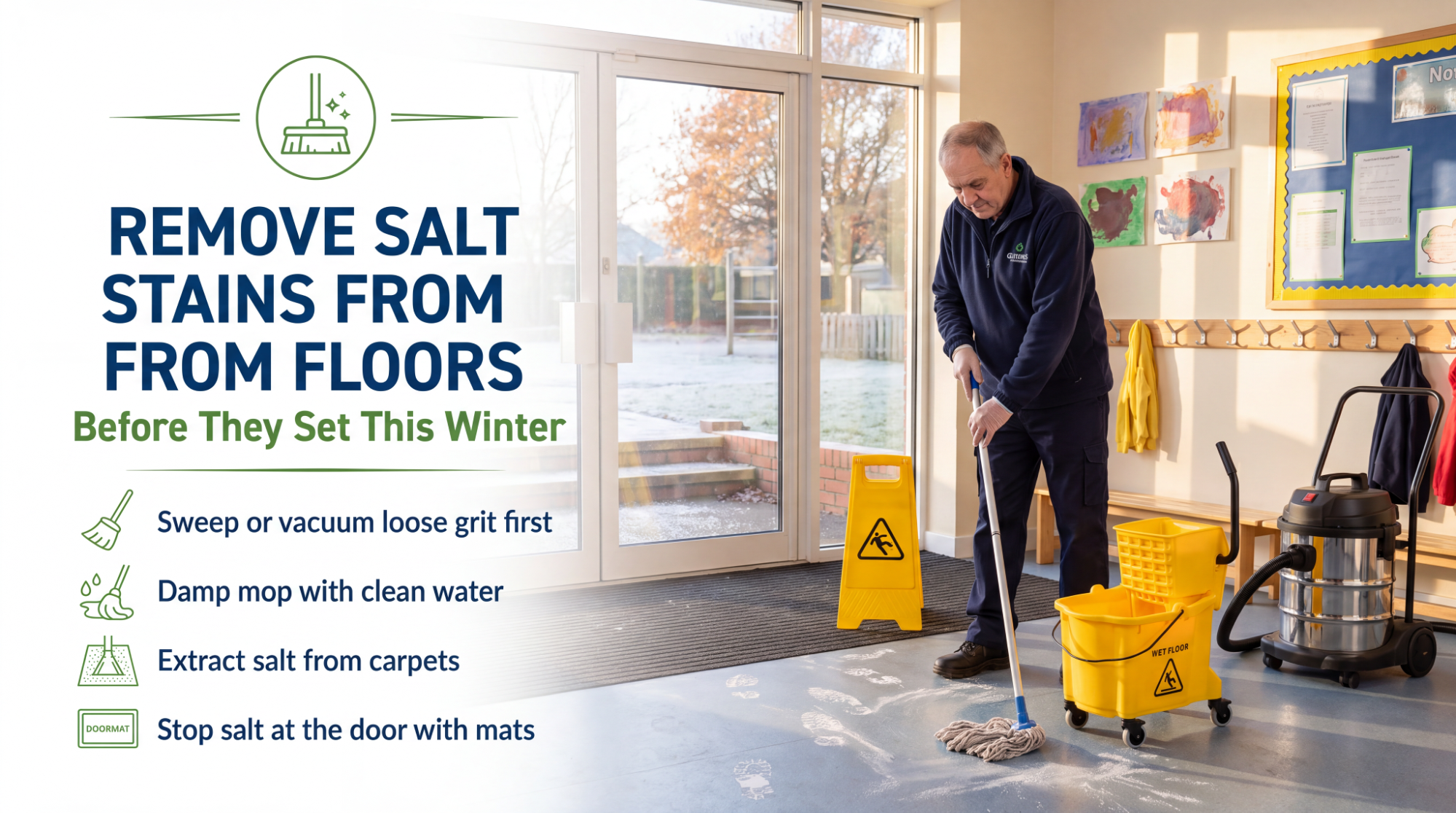
Step 1: Remove loose grit first. Sweep or vacuum dry grit and salt crystals before you add any water. Wet grit scratches the floor under a mop. Citrus lists brooms and wet and dry vacuums, and the vacuum range includes Numatic, Nilfisk, Kärcher, Truvox and Viper.
Step 2: Damp mop with clean water. Because salt dissolves, clean water does a lot of the work. Use a damp mop, not a soaking one, and work from the far end of the area back towards the door. Rinse the mop head often. A dirty bucket simply spreads salty water around.
Step 3: Change the water. Salty water in the bucket puts the salt straight back on the floor. Change the water as soon as it turns cloudy. On a busy entrance, that may mean every few minutes during a wet morning.
Step 4: Clean the floor. Once the salt is gone, use a suitable floor cleaner to remove any remaining film. Follow the dilution on the label, because too much product leaves its own residue. Citrus lists mop heads, buckets and wringers, so you can set up a dedicated entrance kit.
Step 5: Rinse and dry. Go over the floor again with clean water so no cleaner residue is left behind. Then dry it with a dry mop or a wet and dry vacuum, so the floor is safe to walk on. Put out a wet floor sign while the surface dries.
Always check what your floor is made of. Sealed vinyl, ceramic tiles, natural stone and wood all react differently to products and to water. Follow the manufacturer's guidance for your floor, and test any new product in a small hidden spot first. Avoid acidic products on natural stone unless the manufacturer says they are safe.
Remove salt stains from carpet
Carpet needs more care, because salt sits deep in the pile. The aim is to lift it out before it dries into a stiff patch.
Step 1: Vacuum dry. Use a dry vacuum to remove loose grit and surface crystals. Do this before adding any moisture. A damp carpet traps the grit.
Step 2: Pre-treat the worst areas. Citrus lists a Pre-Sprays and Stain Removers subcategory within its Carpet Cleaning range. Its menu describes pre-sprays and stain removers for carpet flooring, but the page does not show product detail. Check the products and their labels before you order. Always follow the dilution and the contact time on the label, and test in a hidden corner first.
Step 3: Extract with clean water. Salt dissolves in water, so hot water extraction is one of the best ways to lift it. A carpet cleaning machine injects water and removes it, taking the dissolved salt with it. Citrus lists carpet cleaning machines from several brands, including Bissell, Kärcher, Numatic, Prochem, Rug Doctor, Truvox, Viper, Nilfisk and Express Solutions. Citrus also lists carpet chemicals, including Rug Doctor Chemicals, a Prochem Natural Range, Njord Chemicals and Elite Carpet Solutions.
Step 4: Rinse. After you clean, rinse with clean water so no product is left in the pile. Product left behind attracts dirt, and the stain returns faster.
Step 5: Dry fully. Use good airflow and open a window if you can. Citrus lists a Sprayers and Air Movers subcategory within Carpet Cleaning. A carpet that dries slowly can smell musty and can start to grow mould. Keep foot traffic off the area until it is dry.
For a light, regular clean on carpet, a dry compound can help. Citrus lists a Dry Carpet Cleaners subcategory, which suits areas where you cannot afford long drying times. Check the product details before you choose.
Protect carpet and keep colours bright
Some sites treat carpet near entrances with a protective treatment. It does not stop salt arriving, but it can make routine cleaning easier. Citrus lists Protective Treatments within its Carpet Cleaning range. Check the details and ask your supplier whether a treatment suits your carpet type.
Stiff, grey patches that remain after cleaning may mean salt is still in the carpet. In that case, repeat the extraction with clean water before you add more product.
Stop the salt at the door
Cleaning is only half the job. The easier way to deal with salt is to stop it coming in.
Start with matting. A long run of entrance matting scrapes grit off shoes and absorbs wet salty water before it reaches the main floor. Citrus lists a Floor Mats subcategory within its Floorcare range. The mats should be long enough that people take several steps on them. Shake out or vacuum them every day in icy weather, and swap saturated mats for dry ones.
Next, treat the outside of the building. Sweep paths and steps so that less salt reaches the door. Use only as much rock salt as you need, because more salt on the ground means more on the floor. A boot scraper or a brush point at the entrance also helps.
Finally, use signs. Put out wet floor signs when the entrance is wet, and remove them when it is dry. Staff should know who is responsible for putting them out and taking them away.
Build a simple winter salt routine
A routine saves far more time than a one-off clean. Here is a pattern that suits most schools, offices and care homes.
Before the building opens, check that the mats are flat and dry, and sweep or vacuum the entrance. During the morning rush, keep a mop and a wet and dry vacuum at hand and clear standing water as it appears. At break and lunch, check the entrances again. At the end of the day, lift the mats, shake them out and clean the entrance floor with clean water.
Once a week, give carpet near entrances a closer clean. Once a month, or more often after heavy salting, do a deeper extraction clean. Keep a short log of what you did and when, so you can see which areas need extra attention.
Order your supplies early
Demand for mops, mats, cleaning machines and carpet products rises as soon as the first frost arrives. Check what you have now. Make sure you have enough mop heads, wet floor signs, cleaning chemicals, cloths and spare mats for each entrance. If a product did not work well last winter, change it before the cold weather arrives.
Remember to check each product label and your COSHH assessment before you use a new product. This guide offers general advice, so always follow your floor and carpet manufacturer's instructions.
FAQ
Why does salt leave white marks on floors? Rock salt dissolves in water on shoes. When the water dries, it leaves the salt behind as a white residue. Regular damp mopping with clean water removes it.
What is the best way to remove salt from carpet? Vacuum dry grit first, then pre-treat if needed, and extract with clean water. Salt dissolves, so extraction lifts it out. Rinse well and dry the carpet fully.
Can I use vinegar on salt stains? Acidic products can damage some surfaces, including natural stone. Follow your floor manufacturer's advice and test a small hidden area first.
How often should I clean entrance floors in winter? Check them several times a day in icy or wet weather. Do a quick clear each morning and again after break and lunch, and clean the whole entrance at the end of the day.
How can I stop salt coming into the building? Use long entrance mats, sweep outside paths, keep rock salt use sensible, and swap mats when they become saturated.